
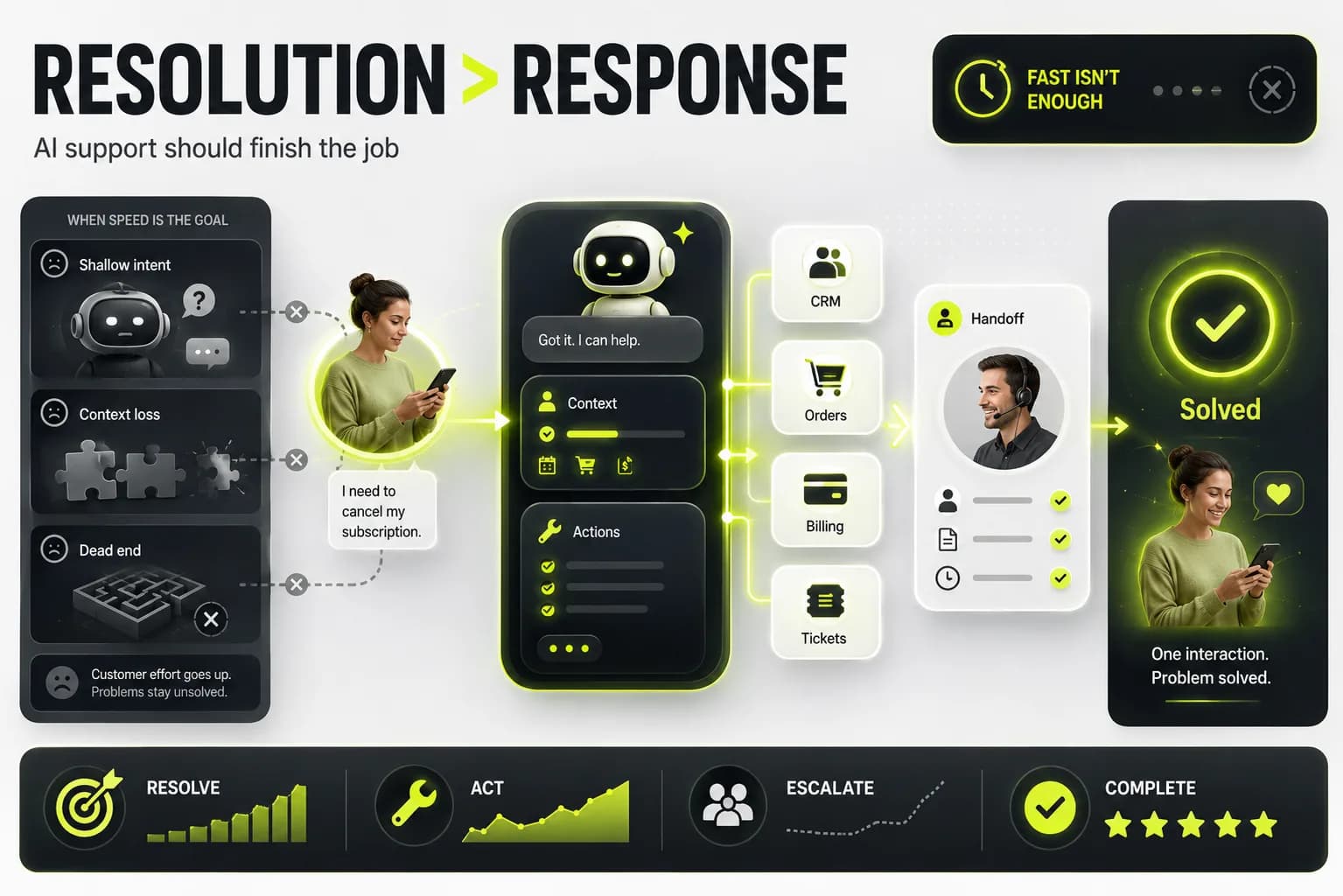
In customer service, speed is now table stakes; AI customer service resolution is the metric that separates a useful agent from a frustrating one. The latest industry data shows a striking gap between what business leaders think AI is doing and what customers actually experience, which is a strong signal that many teams are optimizing the wrong layer of the stack. The real question for engineering leaders is not “Can the bot answer fast?” but “Can it complete the job, or cleanly hand it off?”
The source reporting from CIO’s analysis of resolution-first customer service makes the issue concrete: customers care far more about getting their problem solved than getting an instant, context-free response. That changes how you should design conversational systems, route work, and measure success.
Why fast replies fail as a primary KPI
“Response time” is an attractive dashboard number because it is easy to improve. You can trim prompts, increase concurrency, and shorten wait queues without actually fixing customer pain. But in service workflows, a fast wrong answer is often worse than a slower correct one.
From an engineering perspective, speed-only optimization creates three common failure modes:
- Shallow intent handling: the model identifies the topic but cannot complete the workflow.
- Context loss: the agent does not know who the customer is, what they already tried, or what changed in their account.
- Dead-end automation: the bot reaches its limit and traps the user instead of escalating cleanly.
This is why resolution is a better north-star metric. It aligns product, ML, and platform teams around an outcome users actually feel: the issue is fixed, refunded, changed, reset, or routed to someone who can act.
What resolution-first AI customer service requires
Resolution is not a model-only problem. It is an integration and orchestration problem. A customer support agent that cannot query orders, update subscriptions, issue refunds, or create tickets is just a better FAQ interface.
1) Real-time customer context
Your agent should not depend on the user to repeat their account details every time. A practical implementation usually includes identity resolution, CRM lookup, recent interaction history, and service state. The point is not to dump everything into the prompt; it is to retrieve only the context that changes the next decision.
Engineering trade-off: more context improves accuracy, but it also increases latency, privacy exposure, and the risk of leaking irrelevant data into the model. The solution is selective retrieval, not indiscriminate prompt stuffing.
2) Action-taking capabilities
Resolution happens when the agent can do something: cancel a plan, reset credentials, reopen an order, apply a credit, or create a workflow ticket with the correct metadata. This requires a tool layer with strict permissions and auditable side effects.
A good design pattern is to separate conversation from execution. The LLM interprets intent and gathers confirmation; deterministic services handle the action. That keeps you away from the most dangerous failure mode in AI support: an agent that sounds confident while performing unauthorized changes.
3) Human escalation with state transfer
The source data highlights a persistent gap in seamless AI-to-human handoff. That is not a soft UX problem; it is an architecture problem. A human agent should receive the conversation transcript, detected intent, user identity, action history, and the reason escalation happened. Without that, the user repeats everything and the AI has only succeeded in creating an extra hop.
Good escalation is not “transfer to human.” It is “transfer with the entire working set intact.”
How to measure AI customer service resolution
If your dashboard still prioritizes first-response time, you are measuring the easiest thing to improve. Resolution-oriented teams usually need a different scorecard.
- Containment with quality: how often the agent resolves without human help, adjusted for downstream satisfaction.
- First contact resolution: whether the user leaves with the issue fixed, not merely acknowledged.
- Escalation success rate: how often handoffs preserve context and avoid repeat work.
- Tool success rate: whether actions executed by the agent actually completed and remained consistent in the backend.
- Fallback recovery time: how long it takes to move from failure to human resolution.
One useful rule: if a metric can improve while customer effort increases, it should not be a primary KPI.
A practical implementation checklist for engineering teams
Before you ship or expand AI support, pressure-test the stack with this checklist:
- Map top 10 service intents and label which ones are fully automatable, partially automatable, or human-only.
- Identify the tools the agent must safely call, and define read vs. write permissions explicitly.
- Design a context retrieval layer for identity, order state, tickets, and prior interactions.
- Build a handoff contract so humans receive transcript, intent, confidence, actions taken, and open questions.
- Instrument end-to-end outcomes including resolution, escalation success, and customer effort.
- Red-team failure modes such as stale account data, ambiguous intent, and tool errors.
If any of those steps are missing, you do not have an AI service platform yet. You have a chat layer sitting on top of ticket volume.
Anti-patterns that keep teams stuck on responsiveness
Teams often fall into the same traps when they try to “add AI” to support:
- FAQ inflation: the bot answers more questions, but cannot resolve any of them.
- Prompt-based business logic: critical decisions live in prompts instead of auditable code and policy.
- No stateful conversation design: every turn is treated as independent, so long-running issues break down.
- Escalation as failure: human transfer is treated as a last resort instead of a designed outcome.
These anti-patterns are especially common in startups and mid-market teams racing to show automation gains. The short-term win is a lower queue length. The long-term cost is customer churn and support teams that do cleanup work the bot could not finish.
What technical leaders should do next
If you lead engineering, product, or operations, the shift to resolution-first service should affect your roadmap immediately. Treat conversational AI like a workflow system with language understanding attached, not a language model with a UI.
The best next step is to audit one high-volume support journey end to end. Ask three questions: what data does the agent need, what actions can it safely take, and where should a human take over? Once you have those answers, you can design for the outcome customers actually want.
For teams evaluating their current stack, this is a good time to review architecture choices around tool access, retrieval, escalation, and observability. If you want, DigitioHub can help you assess whether your customer service automation is built for fast replies or real resolution.