
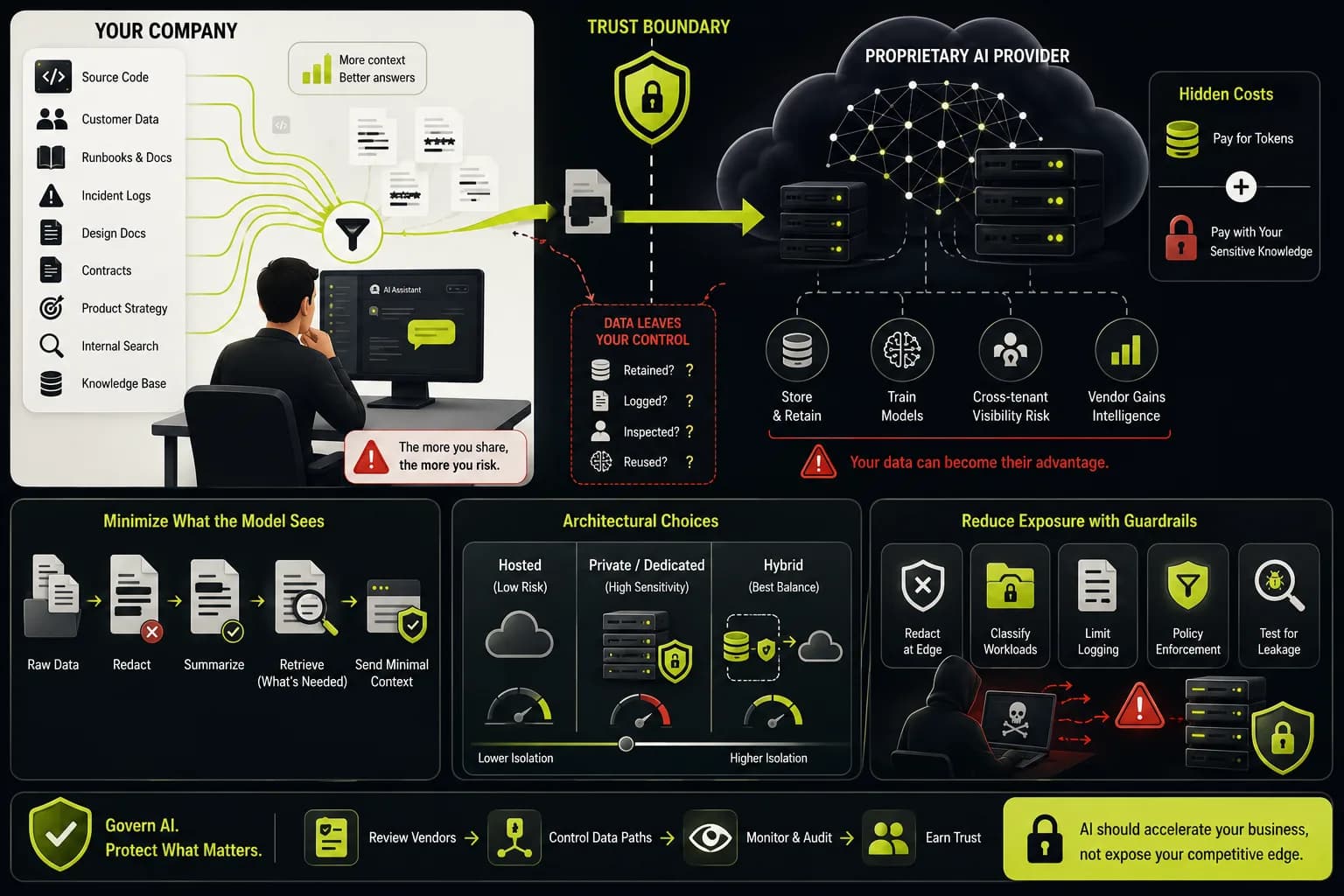
Satya Nadella’s warning about proprietary AI should land as an architecture issue, not a publicity cycle. His point, reported by TechCrunch, is simple: companies are often paying twice for AI — once in tokens, and again in the sensitive knowledge they must reveal to make the model useful. For engineering leaders, that means the default assumption behind many copilots, agents, and vendor-hosted assistants is now a risk decision, not just a productivity decision.
The practical takeaway is this: if your AI system improves because it sees your source code, customer records, runbooks, contracts, or product strategy, you need to treat data exposure as part of the cost model. The question is no longer whether the model is good enough. It is whether the data you feed it becomes a durable asset for the vendor, a retention liability for your company, or both.
Proprietary AI changes the trust boundary
With traditional SaaS, the trust boundary is usually clear: you send structured data to a service, the service processes it, and the provider is expected to keep it isolated. AI complicates that boundary because utility often depends on richer context. The more context you provide — customer notes, code repos, incident timelines, design docs, internal search indices — the better the answer, and the larger the blast radius if that context is retained, logged, or used to improve a model outside your control.
This is why the current debate is not just about privacy policy language. It is about whether proprietary model providers can become, in effect, intelligence aggregators with a view into multiple companies’ most sensitive workflows. Even if a vendor promises separation, the engineering team still has to ask: what leaves our environment, how long is it retained, who can inspect it, and what secondary uses are allowed?
What engineering leaders should ask before expanding AI adoption
Before rolling out a new AI assistant or agent to production teams, ask for specifics. Vague assurances are not enough when the system can ingest source code, incident data, or regulated customer information.
Use this vendor review checklist
- Data retention: Is prompt and output data stored? For how long? Can retention be disabled?
- Training use: Is your data excluded from model training by default, and is that contractual?
- Tenant isolation: How are customer workloads separated at the storage, logging, and feature-flag layers?
- Access controls: Who inside the vendor can access your prompts, traces, or embeddings?
- Encryption and keys: Can you use customer-managed keys, and does that cover logs and vector stores?
- Auditability: Can you prove what data was sent, where it was stored, and whether it was reused?
If the answers are unclear, assume the model boundary is porous.
Minimize what the model sees, not just who sees it
Many teams focus on identity and access management while ignoring prompt design. That is a mistake. The most effective control is often data minimization: send less, not just restrict more.
In practice, that means replacing raw context dumps with narrow retrieval. For example, instead of passing an entire customer support corpus to a chatbot, retrieve only the top relevant paragraphs from an internal index. Instead of sending a full repository, extract the minimal files, symbols, or diffs needed for the task. Instead of sharing raw logs, redact identifiers and sensitive fields before inference.
This shift matters because AI models are unusually greedy consumers of context. A human engineer can solve a task with a summary and a few links. A model may be capable of using far more, but that does not mean it should be given far more.
Where the real architectural trade-offs show up
There is no single right answer for every workload. The right deployment pattern depends on sensitivity, latency, and the value of model quality.
Use a hosted proprietary model when the task is low-risk, the data is low-sensitivity, and speed matters more than perfect isolation. Think public content generation, general-purpose drafting, or internal productivity tasks with no proprietary inputs.
Use a private deployment or dedicated tenant when the workflow touches regulated data, customer secrets, or strategic IP. This may cost more and require more ops maturity, but it reduces the probability that sensitive context leaks across organizational boundaries.
Use hybrid retrieval and local preprocessing when you need model quality but want to keep raw data under your control. This is often the best middle ground: clean, redact, summarize, and retrieve inside your perimeter, then send the smallest useful payload to the model.
Rule of thumb: if the AI assistant is making decisions with data your lawyers would care about, your architecture should assume the vendor can be a risk surface.
Practical patterns that reduce exposure without killing utility
Teams do not need to ban AI to be safe. They need guardrails that map to real production use.
- Redact before inference: Remove secrets, tokens, PII, and customer identifiers at the edge or in a preprocessing service.
- Split context by sensitivity: Keep high-risk documents out of general-purpose prompts; use scoped retrieval instead.
- Log prompts selectively: Store enough telemetry for debugging, but avoid retaining full sensitive prompts by default.
- Classify AI workloads: Create categories such as public, internal, confidential, and restricted, then map each to an allowed model path.
- Test for leakage: Run prompt-injection and data-exfiltration tests against your AI workflows before broad rollout.
One common anti-pattern is allowing teams to paste proprietary context directly into a vendor chat UI because it is “just a pilot.” Pilots become habits, habits become dependencies, and dependencies become unreviewed data flows.
What this warning means for product and platform teams
For product leaders, Nadella’s warning is a reminder that AI feature value must be measured alongside exposure cost. If a feature only works when it receives large amounts of sensitive customer context, you should ask whether the feature can be redesigned around smaller, safer inputs.
For platform teams, the next step is to turn AI governance into infrastructure: approved model routes, policy-based prompt filtering, retrieval controls, and observable data egress. The goal is not to slow teams down. It is to make secure usage the easiest path.
For developers, the design mindset should be familiar: treat prompts, embeddings, traces, and tool outputs as production data. They deserve the same rigor you already apply to APIs, secrets, and logs.
Build an AI stack that earns trust
The message behind this warning is not that AI is too risky to use. It is that many teams are underestimating the hidden cost of context. The vendors selling intelligence may also be learning from the same data you are depending on. That does not automatically make them untrustworthy, but it does mean trust must be engineered, not assumed.
If your team is expanding AI use across code, support, or operations, review the data paths now: what is sent, what is retained, what is reused, and what can be kept inside your own boundary. A short architecture review today is cheaper than a compliance or IP problem later. If you want to pressure-test your current AI stack, start with your highest-sensitivity workflow and evaluate whether the model really needs to see that much context.