
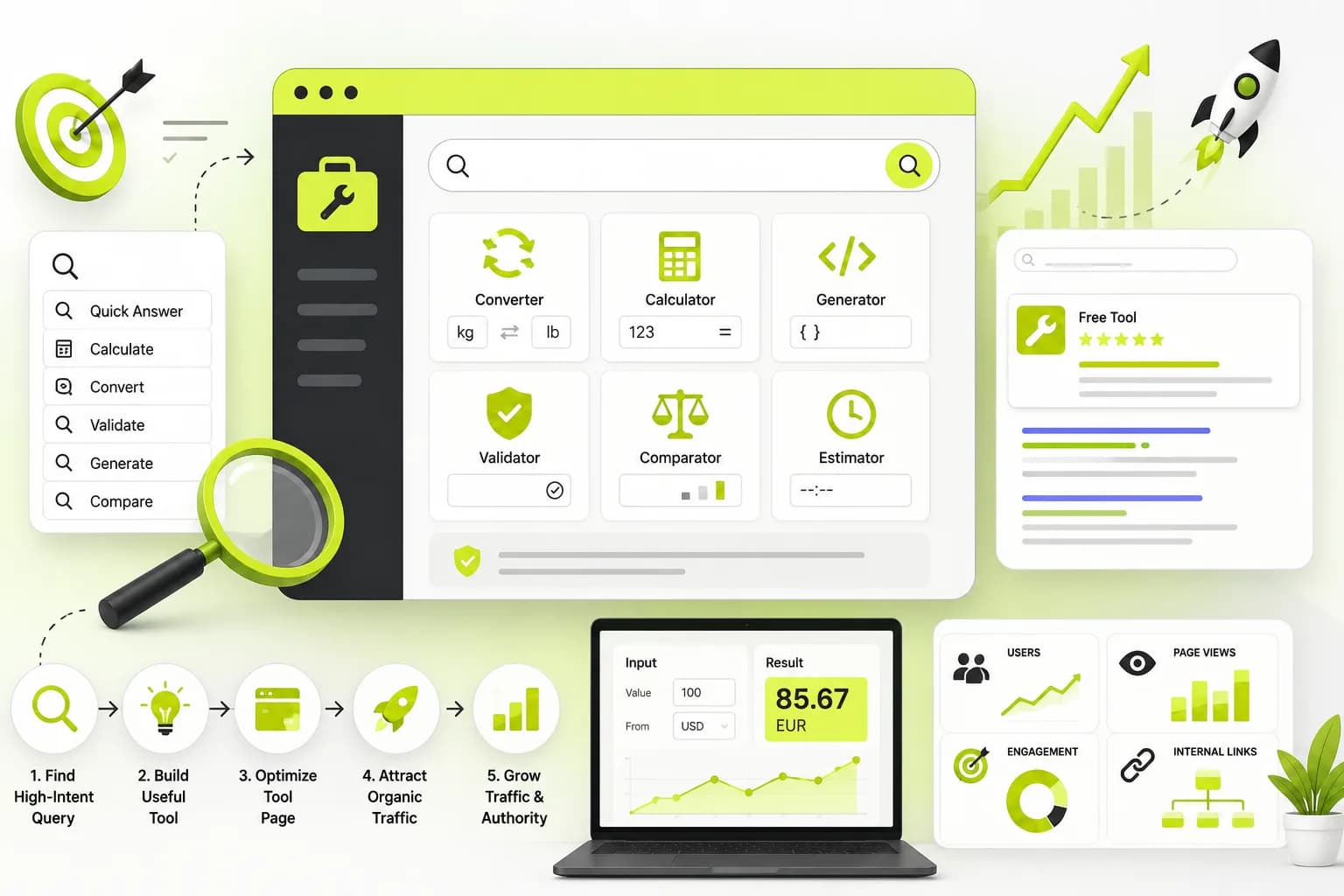
The most interesting takeaway from the recent free tools SEO strategy is not that calculators and generators rank well; it’s that they often solve a search problem better than another long-form article ever could. For engineering leaders, the implication is straightforward: if your team can build a tiny utility that maps to high-intent queries, you can create an acquisition asset that is both genuinely helpful and comparatively easy to maintain. The focus keyword here is free tools SEO, and the opportunity is in shipping useful software, not content fluff.
Why free tools SEO works better than another guide
Many search queries are not asking for education first. They are asking for a quick answer: convert units, estimate something, compare values, validate an input, or generate a small artifact. In those cases, a tool beats an article because it reduces friction. That matters for SEO because search engines try to satisfy intent, not reward word count.
From a product and engineering perspective, this shifts the game in three ways:
- Lower content competition: A useful tool page can outrank broad blog posts if the query is utility-driven.
- Higher engagement: Users interact, return, and share the page when it immediately solves a task.
- Broader lifecycle value: One well-designed tool can support lead generation, internal linking, and product education.
But the real reason this strategy is attractive is that it is technically scoped. You do not need a full SaaS feature. You need a narrow, reliable micro-application with a clear input, output, and edge-case policy.
What engineering teams should build first
If you’re deciding where to start, target high-demand, low-complexity utility queries. Good candidates usually have one of these patterns:
- Converters: bytes to MB, UTC to local time, percentage to fraction, salary to hourly rate.
- Calculators: ROI, burn rate, token usage estimates, break-even analysis.
- Generators: robots.txt snippets, UTM builders, JSON schema stubs, cron expressions.
- Validators: email format checks, password policy checks, webhook payload sanity checks.
For startup teams, the best tool is usually adjacent to your product domain. For example, a data platform might build a query cost estimator or CSV column mapper. A DevOps platform might build a Terraform state size estimator or cron schedule helper. The point is to pick something a target user already searches for before they know your brand.
How to choose a tool page that can actually rank
Ranking potential is not random. A good tool page has three ingredients: search intent match, technical quality, and content depth around the utility. The source article frames this clearly: build a small, genuinely useful tool, place it on a page, and let it compete where there is demand but weak competition. That works best when you validate the query before you write code.
Use this short implementation checklist
- Confirm intent: Search the exact phrase and inspect the top results. If most results are tools, the query is tool-shaped.
- Define the minimum useful output: One screen, one task, no login, no setup.
- Add edge-case handling: Empty inputs, invalid formats, large values, locale differences, and precision rules.
- Expose the result clearly: Show the answer first, then optional explanations or examples.
- Wrap the tool in supporting copy: Explain what it does, who it’s for, and common use cases.
- Instrument usage: Track input starts, completions, and abandonment so you can improve the flow.
Build like a product, not a landing page
The most common mistake is treating the page as SEO content with a widget glued on top. That usually fails because the interaction feels flimsy, and search engines can detect low utility indirectly through engagement signals. A real tool page should behave like a lightweight product.
That means paying attention to the things engineers often skip on first pass:
- Performance: Keep JavaScript lean. If the tool requires a heavy bundle, you’ve probably overbuilt it.
- Accessibility: Inputs need labels, keyboard support, and readable result states.
- Deterministic behavior: The same inputs should produce the same outputs, regardless of browser quirks.
- Error UX: Invalid values should explain the problem instead of failing silently.
- Shareability: Consider URLs with encoded state so users can revisit or share results.
For technical teams, this is also a good place to decide whether the tool should be client-side or server-side. Client-side is usually enough for calculators and converters. Server-side becomes useful when you need rate limiting, auditability, heavier computation, or protected business logic. If the output depends on proprietary data, think carefully before exposing the full algorithm publicly.
SEO mechanics that matter for utility pages
Free tools SEO is still SEO, which means the page must be understandable to crawlers and compelling to users. A pure JavaScript app with no crawlable context is risky. The best-performing utility pages usually combine a fast interactive core with enough static content to clarify purpose and intent.
Include these elements on the page:
- Title tag and H2 alignment: Match the target query without sounding robotic.
- Concise explanatory copy: Explain what the tool does in plain language.
- Examples: Show sample inputs and outputs to reduce ambiguity.
- FAQ-style support: Answer edge questions that users may search next.
- Internal pathways: Point users to related tools or documentation.
One useful rule: the tool should answer the query in under 10 seconds for a first-time user. If it takes longer, you may still rank, but you’ll leak conversions. In other words, search traffic is not enough; the user experience has to justify the click.
Common anti-patterns that waste engineering time
Not every tool idea deserves a sprint. Avoid these traps:
- Building for vanity keywords: High volume does not matter if the query is not utility-driven.
- Overengineering the backend: If a simple function will do, do not add queues, auth, or microservices.
- Hiding the utility behind marketing copy: The tool must be immediately usable.
- Ignoring maintenance: Rates, formulas, regulations, and APIs change; some calculators will need periodic review.
- Launching without measurement: If you cannot see usage drop-off, you cannot improve the page.
Also beware of tool sprawl. A portfolio of 20 low-quality utilities is worse than five genuinely excellent ones. Search visibility tends to follow usefulness, and usefulness tends to follow deliberate scope.
What technical leaders should do next
If you lead engineering or product, the strategic decision is not whether free tools SEO is clever. It is whether you can turn a search query into a low-cost, high-value utility without distracting the team from core product work. In many cases, the answer is yes if you treat it as a small product initiative with clear ownership.
Use this decision framework:
- Search demand exists: people already look for the exact problem.
- Utility is narrow: one job, one page, one obvious result.
- Implementation cost is modest: a few days, not a quarter.
- Maintenance burden is acceptable: no fragile dependency chain.
- Business relevance is clear: the tool attracts the audience you want.
Free tools SEO works best when the page behaves like a product, the query has real intent, and the engineering scope stays intentionally small.
Build the utility, then prove it deserves the traffic
The lesson from this strategy is practical: stop assuming every SEO win requires another 2,000-word guide. Sometimes the better move is a calculator, converter, or generator that genuinely solves a repeated problem. For engineering teams, that’s a comfortable kind of SEO because it rewards product thinking, not content theater.
If you’re evaluating your current stack, this is a good moment to review which lightweight utilities you could ship quickly, what can be rendered statically, and where performance or crawlability might limit growth. If you want to discuss architecture choices or validate whether a tool idea is worth building, start there before writing a single line of copy.