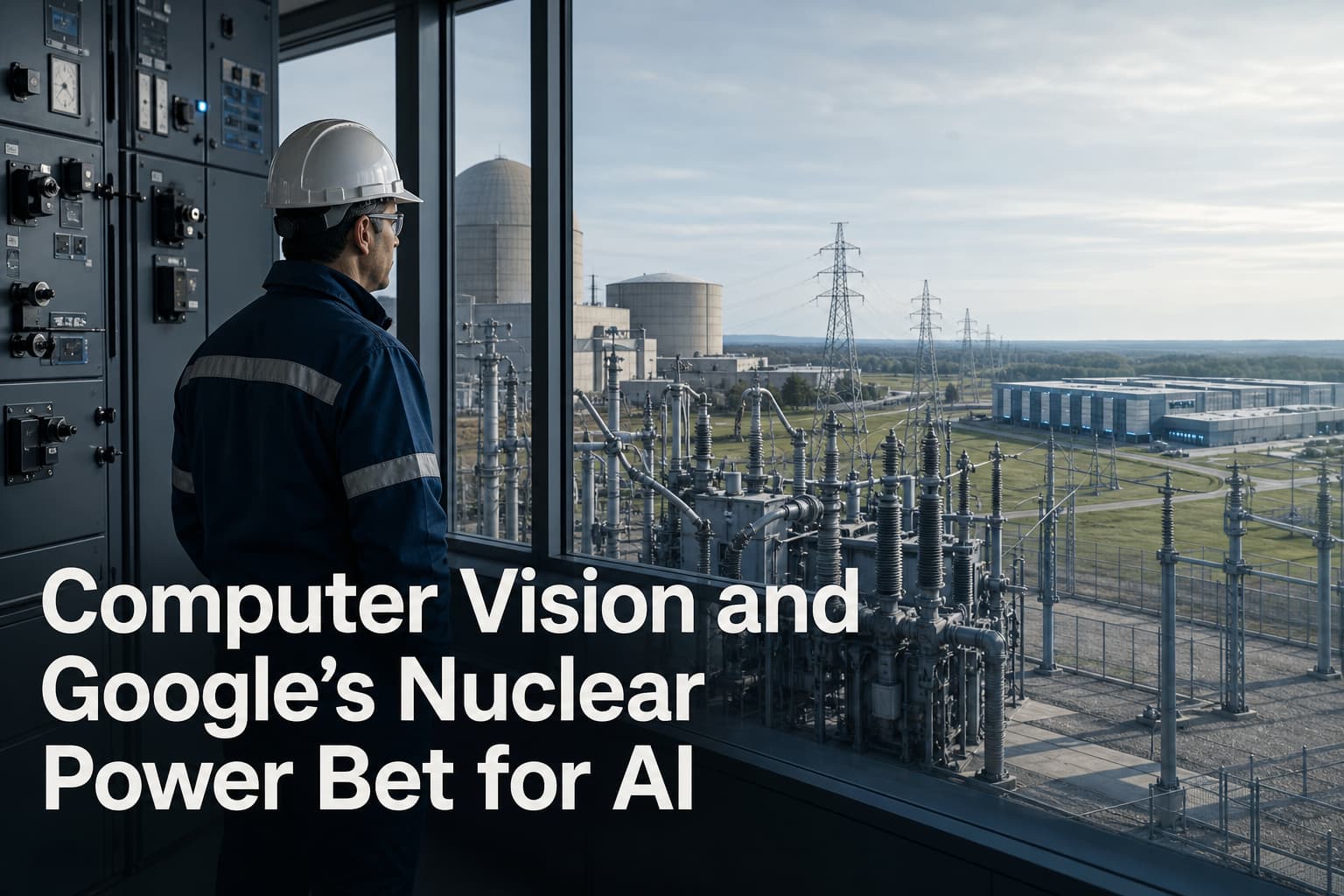
Google’s agreement to secure nuclear electricity for AI data centers points to a constraint many software teams underweight: dependable power. That matters even if you are building products around computer vision or natural language processing. The models may run in the cloud, but their availability still depends on physical capacity, commercial commitments and operating infrastructure.
The practical answer for founders is not to become energy traders. It is to treat compute availability as part of product and business planning, then look for software opportunities around the assets that make large-scale AI possible.
The Google nuclear power agreement is a capacity decision
Google has entered a 20-year power purchase agreement with Constellation for 890 megawatts of nuclear energy connected to the PJM Interconnection grid. That grid serves 13 Mid-Atlantic and Midwest states and about 67 million people. The arrangement is intended to support upgrades across 11 nuclear power units at six facilities in Illinois, New Jersey and Pennsylvania.
Figures mentioned are indicative and may vary depending on contracts, operating conditions, assessment, region and market conditions.
Constellation is expected to spend more than $4.3 billion on modernisation work, including turbines, steam generators and digital control systems. Google has not disclosed the price it will pay for the power, so the capacity figure alone does not establish whether the arrangement is economically attractive for every party.
Figures mentioned are indicative and may vary depending on contracts, operating conditions, assessment, region and market conditions.
There is also a separate 15-year supply deal for 2,700 megawatts from Constellation’s existing plants. That creates an important distinction: one commitment supports upgrades intended to bring additional energy onto the grid, while the other draws on assets already operating.
Figures mentioned are indicative and may vary depending on contracts, operating conditions, assessment, region and market conditions.
Why reliable electricity changes AI data-center planning
A data center does not benefit from energy merely because it exists somewhere on an annual ledger. Computing workloads need power where the facility operates and when the workload runs. The relevant questions include transmission access, plant performance, maintenance schedules and the obligations in the supply agreement.
This changes how technology leaders should evaluate AI roadmaps. A model that looks affordable at the application layer may have different economics when demand grows, inference becomes continuous or workloads require a more dependable operating schedule. A long-term contract may provide clearer access to electricity, but it can also reduce flexibility if demand, architecture or location changes.
That is the trade-off behind Google’s arrangement. Constellation receives revenue visibility that can support upgrades, while Google receives a long-term path to nuclear supply, subject to the agreement’s commercial and operational terms. Neither side removes the need for execution discipline.
For large AI deployments, electricity is not just a facilities input. It is a product-planning dependency.
The industrial software layer behind the power deal
Google Cloud will provide Constellation with cloud computing resources and the Gemini Enterprise platform under a five-year contract. The stated applications include site selection, outage management, critical infrastructure protection and generator dispatch optimisation.
Figures mentioned are indicative and may vary depending on contracts, operating conditions, assessment, region and market conditions.
What caught my attention is the two-way structure. Google is securing power from a major energy producer, while its cloud business is supplying software intended to support that producer’s planning and operations. This is more specific than a general claim that AI will transform industry: the value is attached to defined workflows with physical consequences.
That creates a useful product test for founders. If your software touches power generation or other critical assets, the buyer may care less about a generic model demonstration and more about whether the system connects to existing data, records why a recommendation was made and gives an operator a clear way to reject or escalate it.
An ai agents approach may help coordinate tasks such as gathering maintenance information or routing an operational request, but it does not remove the need for permissions, audit trails and accountable operators. The closer a product gets to physical infrastructure, the more important those boundaries become.
What the historical pattern says about infrastructure
Electricity created value beyond the power station itself. Once factories could access dependable electrical supply, businesses developed new machinery, layouts and production processes around it. The infrastructure changed the economics of what could be built.
The Google-Constellation arrangement follows a similar pattern. Large-scale AI demand is encouraging a technology company to make a long-term commitment to an energy asset, while the energy producer is using cloud resources and software in its operating environment. The shift is not simply from one energy source to another. It is a tighter connection between computing demand and industrial capacity.
The effect chain is straightforward:
Large AI workloads increase demand for dependable electricity.
That demand makes existing power assets and upgrade programmes more strategically valuable.
Those assets require software for planning, monitoring, protection and operational decisions.
The opportunity therefore moves beyond model development into the coordination layer around energy and other constrained physical systems.
A decision framework for founders planning AI capacity
Before committing to a major AI deployment, use this checklist:
- Classify the workload. Separate training, real-time inference, batch processing and storage. Their timing and reliability requirements may differ.
- Map the physical dependency. Identify which services depend on a specific region, provider or facility and which can be moved or delayed.
- Read the commercial terms. Review duration, pricing, capacity commitments, maintenance provisions and the consequences of changing demand. Terms remain subject to negotiation and assessment.
- Define operational authority. Decide which actions software may recommend, which actions require approval and which system remains authoritative during an incident.
- Design the exit path. Document how workloads can shift between providers, regions or architectures if the original arrangement no longer fits.
A common mistake is to leave energy planning with facilities teams while product teams plan AI adoption separately. The two decisions can interact. A product roadmap can increase demand for computing capacity, while the available capacity can influence service design, latency expectations and launch sequencing.
Where founders can build around existing energy assets
The opportunity suggested by these agreements is not necessarily reactor ownership. It is software that makes existing assets easier to plan, operate and govern.
Potential areas include workload scheduling that responds to capacity constraints, maintenance planning, operational-data reconciliation, site-selection analysis and decision support for generator dispatch. Each requires integration with real processes rather than a standalone chat interface.
For systems connected to critical infrastructure, penetration testing should sit alongside access controls, audit trails and incident procedures. Those controls create additional work and may affect deployment timelines, but they are part of the product’s adoption requirements.
A ci cd pipeline can help manage controlled software releases, while environment-specific testing and human approval remain important for high-consequence systems. Similarly, reinforcement learning may suit some sequential optimisation problems, but it does not substitute for reliable data, domain constraints or process ownership.
Prompt engineering may improve how operators interact with a language model, but the commercial question is broader: can the system produce traceable, useful decisions inside an existing workflow?
Teams working with visual inspections should define what evidence a model must provide before an operator acts. Teams processing documents or incident notes should preserve links to the underlying information. In both cases, model capability is only one part of deployment readiness.
What “computer vision” and natural language processing mean here
People searching for “computer vision” may be looking for ways to analyse images or video. In an energy setting, that could relate to inspection, maintenance or safety workflows, but the value depends on image quality, deployment conditions and review procedures.
What is natural language processing? In this context, it refers to systems that work with text such as maintenance records, operating procedures or incident notes. The output still needs to be traceable to the underlying information and reviewed according to the consequence of an incorrect recommendation.
These tools are most useful when attached to a defined operational decision. They should not be presented as a substitute for understanding the asset, the operator or the cost of an error.
The strategic takeaway for AI builders
Google’s nuclear power commitment shows that large AI deployments are becoming linked to long-term energy planning. The arrangement also demonstrates a second layer: the same relationship can include software intended to improve the energy producer’s operations.
For founders, three questions are worth asking before adding another model feature: Which physical constraint could limit deployment? Which workflow absorbs that constraint? What evidence would persuade an operator to use the product?
The answer will depend on the product and market. If your roadmap relies on computing capacity, energy availability and operational trust, evaluate those dependencies early. Explore more practical thinking on AI, automation and execution through the Yanisa Execution blog, or compare your approach with the team where the problem is operationally complex.
Frequently Asked Questions
Why is Google securing nuclear power for AI data centers?
The arrangement gives Google a long-term path to dependable nuclear electricity for AI data-center demand. It also supports upgrades to existing nuclear facilities, subject to the commercial and operating terms of the agreements.
How much nuclear power is included in Google’s agreement with Constellation?
The agreement covers 890 megawatts through a 20-year power purchase agreement, plus a separate 15-year supply deal for 2,700 megawatts from existing plants. Figures mentioned are indicative and may vary depending on contracts, operating conditions, assessment, region and market conditions.
What will Google Cloud provide to Constellation?
Google Cloud will provide computing resources and the Gemini Enterprise platform through a five-year contract. The stated applications include site selection, outage management, critical infrastructure protection and generator dispatch optimisation.
Can nuclear power help address AI data-center electricity constraints?
It may provide a dependable electricity source for large computing operations, but the outcome depends on transmission, plant performance, maintenance, contract terms and local infrastructure. It does not remove the need for workload planning and operational review.
What can founders build around AI data-center energy demand?
Founders may find opportunities in workload scheduling, maintenance planning, operational-data coordination, site-selection analysis and decision-support software. Products in these areas generally need strong integration, security controls, traceability and clear human accountability.