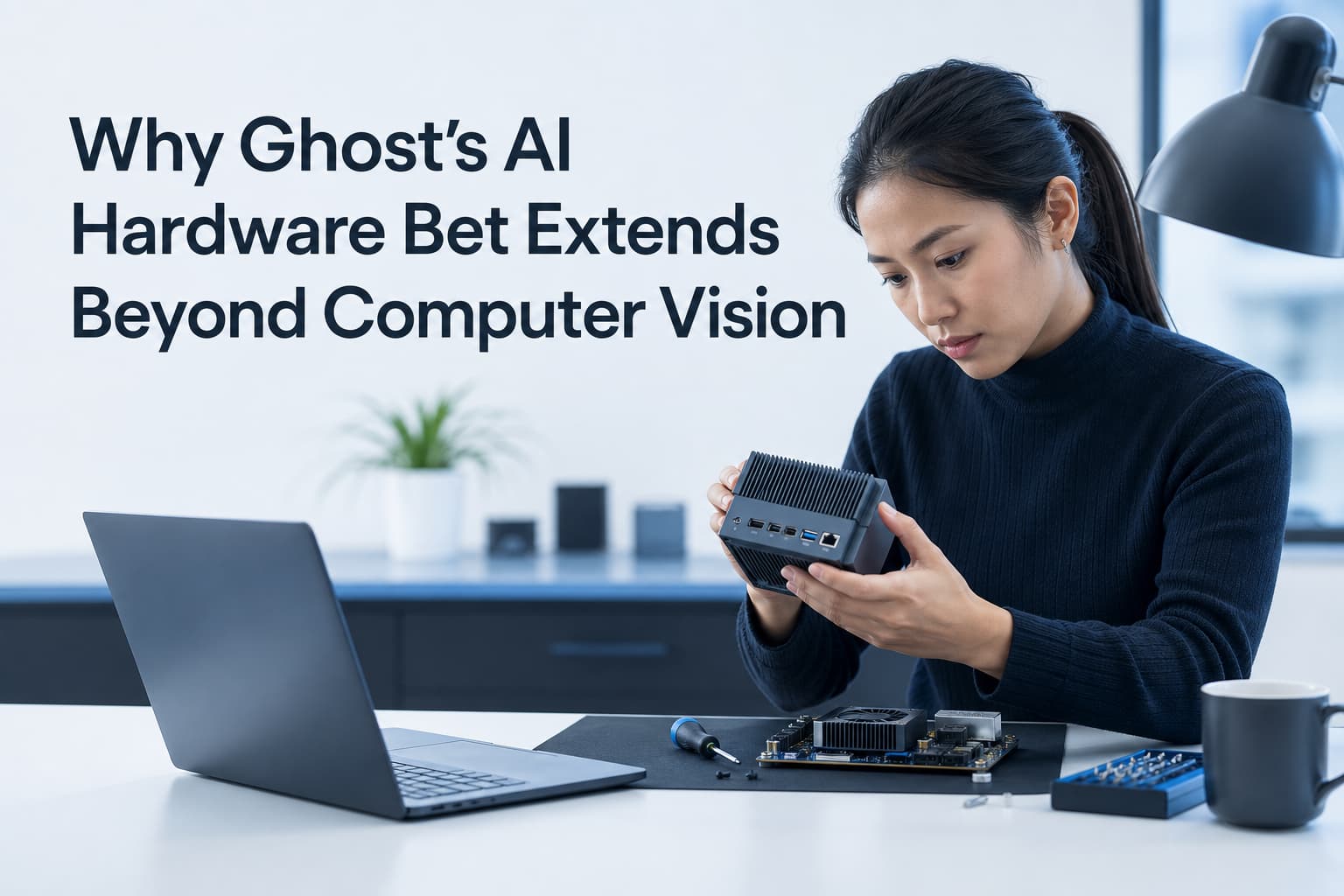
Ghost AI’s funding announcement matters because it tests a bigger product question: should personal AI agents live on infrastructure controlled by a cloud provider, or on a computer owned by the user? The company has raised $11 million to develop Core, a dedicated machine for running personal agents locally. Figures mentioned are source-reported and may vary depending on reporting context and market conditions.
The implication reaches beyond computer vision. It also applies to natural language processing, private document search, workflow automation and any system that needs sustained access to a person’s context. For founders, the practical question is not whether local AI sounds attractive. It is whether the control gained justifies the hardware, maintenance and security responsibilities that come with it.
According to the source report, Core does not use a conventional monitor or desktop interface. Users manage it through a smartphone and web application, while the device supplies the compute, storage, models and controls needed for local workloads. That makes it closer to a dedicated private server than another consumer gadget competing for screen time.
Why Ghost’s local agent computer changes the product boundary
Most AI products are delivered as hosted services. The provider controls the models, application layer, storage and update process. This makes distribution easier, but it also creates dependency: private context may pass through systems the user does not operate, and the product can change when the provider changes its model access, pricing or policies.
Ghost is taking the opposite position. The company says Core keeps source code, model weights, logic and user data on the device. It also describes user-controlled encryption keys, a firewall that monitors outgoing requests and support for additional open-source models. These choices may reduce dependence on external services, but they do not remove operational work. The owner still has to manage physical access, backups, recovery keys, patching and device failure.
That trade-off is the important part. A local machine may provide more control over sensitive context, while shifting responsibilities that a cloud provider would normally handle. Privacy is not only a storage decision; it also depends on permissions, update integrity, incident response and the behaviour of people using the system.
What the personal computer precedent reveals
The personal computer changed computing by moving control closer to the user. Teams could run software locally, store files on their own machines and build workflows without requesting access from a central operator for every change. That shift created demand for operating systems, developer tools, security products and technical support.
Ghost’s proposal follows a similar pattern, but the scarce resource is not simply compute. It is context. A local machine dedicated to personal agents could keep files, preferences, instructions and task history close to the execution layer. The potential benefit is tighter control and reduced dependence on a remote service. The cost is that the owner now operates a more capable and more consequential endpoint.
What caught my attention is Ghost’s longevity argument. The company says Core should continue working even if Ghost disappears because the relevant code, models and logic are stored on the device. That is a useful durability test, but it raises a harder question: can another operator inspect, update, repair and secure the system without the original vendor?
Where computer vision and local inference fit
Dedicated hardware becomes more compelling when an agent must process sensitive information continuously or operate with limited connectivity. In computer vision, that could include analysing cameras, documents or physical environments locally. In natural language processing, it could include searching internal files, drafting from confidential context or coordinating routine work without sending every document to a third party.
The source report says Core uses an Nvidia RTX Pro 4000 SFF Blackwell graphics processing unit and includes several open-source models, with the option to download more from model repositories. That creates flexibility, but also adds complexity. Model compatibility, memory requirements, licensing, update integrity and inference speed become part of the product experience.
Local does not automatically mean superior. A cloud provider may offer larger models, managed redundancy and specialised support. A local device may offer more control but require more technical ownership and impose limits on model size or throughput. The right choice depends on data sensitivity, response-time requirements, downtime tolerance and the team’s ability to operate hardware.
The effect chain founders should watch
- Private context moves closer to execution. If files, instructions and memory remain on a user-controlled device, some workflows can be designed around local access rather than repeated cloud uploads.
- Product value shifts toward control. Permissions, memory, audit trails, updates and recovery become as important as the underlying model.
- New support categories emerge. Local model evaluation, device administration, backup tooling and security testing become more valuable because the endpoint is doing more than storing files.
This is why the story is larger than a funding round. It suggests that AI hardware may increasingly be evaluated as a combination of workstation, server and security boundary. That is a different buying decision from subscribing to an AI application.
A practical framework before buying or building
Do not begin with “Can we run an agent locally?” Begin with the workload and its failure mode. Use this checklist:
- Classify the data. Separate public, internal, confidential and highly sensitive information. Greater sensitivity may strengthen the case for local processing, but it also demands stronger access controls.
- Measure the workflow. Record response-time needs, task volume, model size, context length and how often the system must work without connectivity.
- Calculate ownership effort. Include hardware replacement, electricity, storage, backups, model updates, monitoring and technical support—not only the purchase price.
- Test the boundary. Use penetration testing to examine exposed interfaces, mobile access, update mechanisms and agent permissions. Local deployment reduces some external dependencies but does not remove attack surfaces.
- Define the release process. Treat model files, prompts and policy changes as production artefacts. A disciplined ci cd pipeline may help teams review and roll back changes, although it requires clear ownership and testing.
Prompt engineering can shape agent behaviour, but prompts should not be treated as a security boundary. Reinforcement learning may improve behaviour in some systems, but it does not remove the need for permissions, logging or escalation when actions have material consequences.
For many companies, a hybrid architecture may be more practical than choosing one side. Sensitive retrieval, private memory or narrow workflows can run locally, while less sensitive or compute-heavy tasks use a cloud service. That can reduce hardware requirements, but it introduces routing logic, data classification and more complex observability.
What builders should take from Ghost’s bet
The immediate opportunity is not to copy a “brain in a box.” It is to build the management layer around personal intelligence. That could include model packaging, permission systems, local evaluation, backup and recovery, device fleet administration or tools that show exactly what an agent accessed and changed.
The source report says Ghost’s first batch cost $3,499 per device and sold out, with the company collecting interest for a second batch. Figures mentioned are source-reported and may vary depending on eligibility, assessment, region and market conditions. A purchase at that level should be evaluated as an infrastructure decision, not an ordinary software subscription. Estimate total ownership cost, identify who will maintain the device and define what happens if the vendor stops shipping updates.
The architectural lesson is straightforward: if an agent is expected to understand a person’s work deeply, memory, permissions and execution need to be designed together. Treating the model as the whole product leaves the most consequential risks—and opportunities—outside the design.
The next advantage in personal AI may not come from owning the largest model, but from controlling where context is stored and what the system is allowed to do.
For more operator-focused analysis on AI products, automation and technical strategy, explore the Yanisa Execution blog or compare architecture options with your team before committing capital.
Frequently Asked Questions
What is Ghost AI building?
Ghost AI is developing Core, a dedicated computer intended to run personal AI agents locally. The device is designed to be managed through a smartphone and web application rather than a conventional monitor and desktop interface.
Why would someone run AI agents locally instead of in the cloud?
Local execution may give users more control over private data, model files and system behaviour. It can also create additional responsibilities for hardware maintenance, backups, security updates and recovery.
Can Ghost Core run open-source AI models?
According to the source report, Core ships with several open-source models and allows users to download additional models from repositories such as Hugging Face. Compatibility, licensing and hardware requirements should be checked for each model.
Does local AI hardware remove cybersecurity concerns?
No. Local deployment can reduce reliance on external services, but the device, applications, update process and agent permissions still need protection. Security testing, access controls and monitoring remain important.
What should founders evaluate before buying dedicated AI hardware?
Founders should assess data sensitivity, model and response-time requirements, expected workload, ownership costs, maintenance capacity and recovery plans. A hybrid design may be more practical when some workloads need cloud-scale compute.