
Salesforce plans to acquire Braze for $5.66 billion in cash, valuing the marketing software provider at $47.5 per share, about 58% above its last closing price. Braze’s revenue grew 26% year on year to $227.2 million in its latest quarter.
That price points to a decision founders and marketing leaders should care about: are marketing automation tools being judged by the content they generate, or by how much campaign work they connect?
The useful answer is the second one. The deal shows why customer records, segmentation, delivery controls and measurement need to be designed as one workflow, with human review still responsible for the decisions.
The Braze transaction puts a clear value on connecting customer data to campaign decisions across several channels.
- Braze’s value sits across data ingestion, standardisation, segmentation, delivery and measurement rather than copy generation alone.
- AI-assisted campaign production becomes more useful when teams define audience, product, frequency and approval parameters.
- The practical buying decision is whether a workflow fits existing data, channels and accountable marketing roles.
The acquisition targets disconnected campaign work
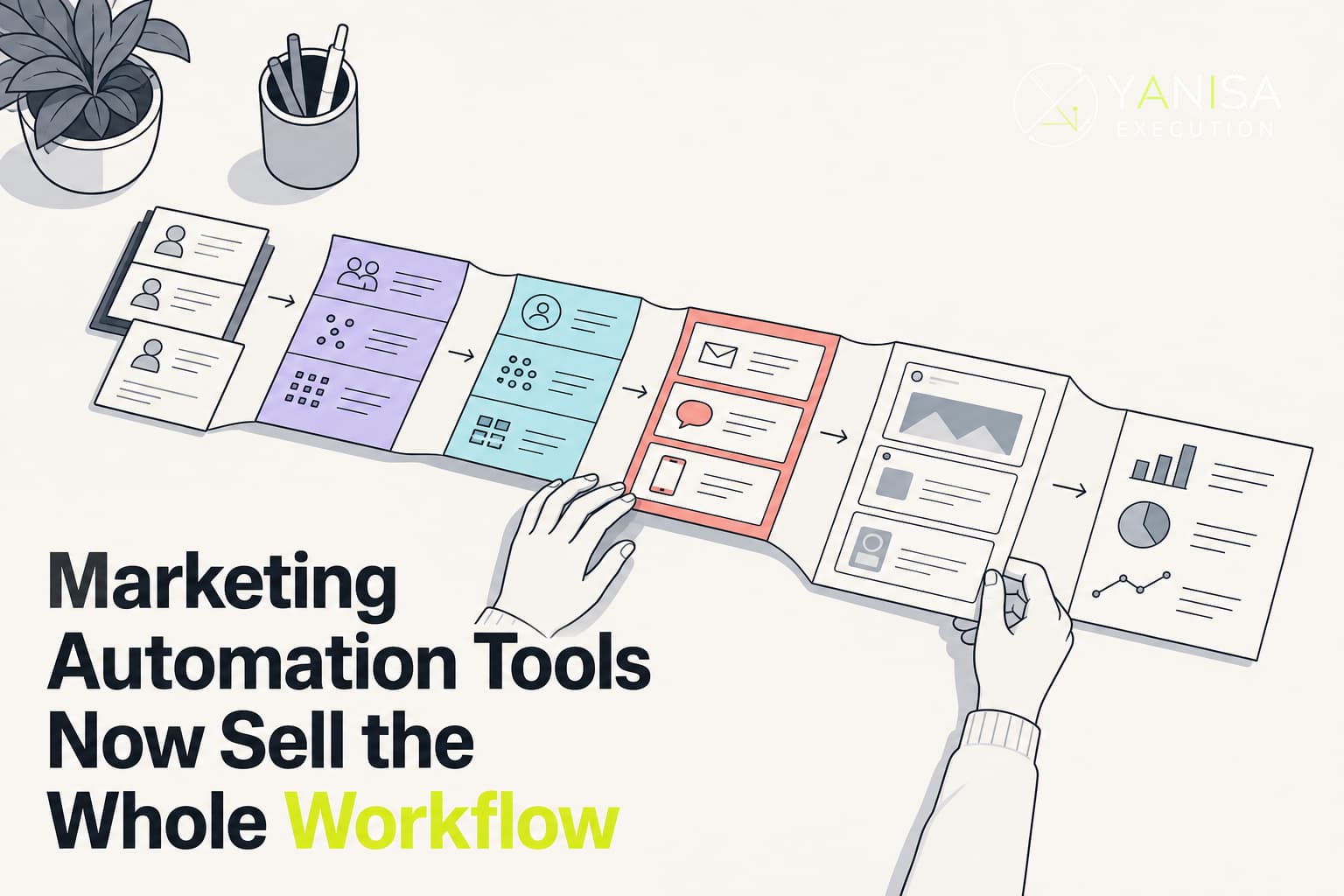
Braze brings customer information together from separate systems through more than 190 pre-packaged connectors. It then organises incoming information into a standardised format using user-created scripts, groups customers into segments and supports personalised campaigns for those groups.
That sequence explains the strategic value more clearly than the word “AI”. An electronics retailer, for example, could define a segment containing shoppers who bought smartphones through its website, then create a campaign for that audience. The useful output depends on reliable records, an inspectable segment and a clear link between the audience and the message.
Braze also supports distribution through a company website, mobile application, SMS, WhatsApp and other channels. Its observability dashboards show measures such as the percentage of recipients who clicked a shopping link in a sales email, giving marketers a way to inspect channel behaviour rather than treating delivery as the end of the process.
Salesforce says it intends to use the technology to improve Marketing Cloud’s ability to personalise campaigns across multiple outreach channels. The announced acquisition is expected to close in Salesforce’s 2028 fiscal year, which starts next February, subject to the transaction process.
Revenue growth does not remove workflow risk
The financial comparison is significant but easy to misread. Braze’s revenue rose 26% year on year to $227.2 million in its latest quarter, while its adjusted operating income nearly quadrupled. Those figures help explain the commercial interest in Braze, but they do not establish the return a particular customer may receive from adopting similar capabilities.
The operating issue is more basic. Each connected stage creates a responsibility: connectors determine which records enter the workflow, scripts shape how those records are represented, segments decide who is addressed, and campaign settings govern what is sent and when.
AI can make the visible part faster while leaving the hidden decisions unresolved. BrazeAI can create campaign materials such as promotional emails using parameters including product availability and purchase history, but a generated message still needs a person to check the audience, claims, offer and delivery conditions.
That is the common mistake in evaluating marketing automation tools: treating generated copy as the product rather than one step inside a controlled sequence. A system may produce more variants while making weak data definitions and unclear approvals harder to notice.
Standardisation is the historical pattern
Containerised shipping offers a useful precedent. Freight once moved through many separate handling steps, with inconsistent packaging creating delays and additional coordination. Standard containers did not eliminate ports, carriers or inspections; they gave different participants a common unit that could move through several stages.
The same pattern appears in Braze’s design. Customer information arrives through different connectors, is reshaped through user-created scripts, and becomes usable for segmentation and campaign delivery. Standardisation makes the hand-offs easier to inspect, but it does not decide whether the underlying data is appropriate or whether a segment deserves a particular message.
What caught my attention was the gap between a polished campaign demonstration and the work underneath it. The demonstration shows an email or notification. The operating system is actually a chain of records, transformations, audience rules, channel choices and measurements, each with a possible failure point.
The likely direction follows that pattern: as campaign creation becomes easier to automate, differentiation moves towards the quality of the data model and the review process around it. The team that documents those hand-offs can assess AI output more intelligently than a team comparing message samples alone.
Guardrails move from policy into the workflow
Braze’s Agentic Standards feature illustrates the change. Users can define guardrails for AI-generated campaigns, such as a maximum number of times an advertisement can be shown to a shopper. The feature can represent a business rule, but the marketing team still needs to decide which rule matters, what data triggers it and who checks the result.
The effect chain is direct: connected records feed segments, segments shape campaign material, campaign rules constrain distribution, and channel dashboards expose the interaction. The bottleneck moves from producing a message to reviewing the inputs and controls that made the message eligible for delivery.
Data ownership. Identify where purchase history, product availability and customer activity enter the workflow. Connectors can bring information together, but they do not settle conflicting fields or define which record should guide a campaign.
Audience design. Write the segment in observable terms, such as website shoppers who bought smartphones. A concrete definition can be inspected against records; a broad description makes approval and measurement harder.
Campaign control. Turn important limits into explicit rules, including advertising frequency where relevant. The rule needs an owner and a review step because the capability does not determine how the business should use it.
Measurement. Read click behaviour alongside the audience, product and channel conditions that produced it. A dashboard can display an interaction, but it cannot explain every commercial reason behind that interaction.
What this means for your marketing automation tools
Founders and operators should compare the complete path rather than the most impressive generation demo. Salesforce’s stated aim is to strengthen cross-channel personalisation through Braze technology, while the planned closing remains subject to the acquisition process. Your own decision should therefore begin with the workflow you can inspect today.
Trace one audience. Follow a defined customer group from source records through segmentation, campaign creation, delivery and measurement. This exposes the hand-offs that a feature list usually hides.
Document the data layer. Record where purchase history and product availability enter the process, and identify the scripts that standardise them. If those fields cannot be traced, campaign personalisation may be difficult to review.
Assign the approval layer. Name the person responsible for checking audience logic, generated material and frequency controls before delivery. AI assistance can reduce repetitive work, but it does not remove accountability.
Compare channel evidence. Inspect website, mobile application, SMS and WhatsApp delivery alongside performance dashboards. A workflow that handles one channel well may still leave the business reconciling other channels separately.
Evaluate the integration boundary. Ask whether connectors, standardisation, segmentation, campaign creation and observability belong in one managed process or several separate tools. The answer should reflect your data quality and review capacity, not just the number of campaign variants demonstrated.
Marketing automation tools are becoming a workflow decision because the value sits between customer records and measured action. For more practical analysis of AI-assisted operations, explore the Yanisa Execution blog or compare the relevant design options with the Yanisa team.
Frequently Asked Questions
Why is Salesforce acquiring Braze?
Salesforce says it plans to use Braze technology to strengthen Marketing Cloud’s ability to combine customer data and personalise campaigns across multiple outreach channels. The announced transaction is valued at $5.66 billion in cash.
How much is Salesforce paying for Braze?
The announced deal values Braze at $5.66 billion in cash, or $47.5 per share. That is about 58% above Braze’s last closing price based on the stated terms.
What does Braze do for marketing teams?
Braze can bring customer information from different systems into a standardised format, group customers into segments and support personalised campaigns. It can distribute messages through websites, mobile applications, SMS, WhatsApp and other channels.
What is BrazeAI used for?
BrazeAI can create campaign materials such as promotional emails using information including product availability and purchase history. Marketing teams still need to review the audience, content and campaign controls before delivery.
When is the Salesforce and Braze acquisition expected to close?
Salesforce expects the acquisition to close in its 2028 fiscal year, which starts next February. The timing remains subject to the transaction process and may change.