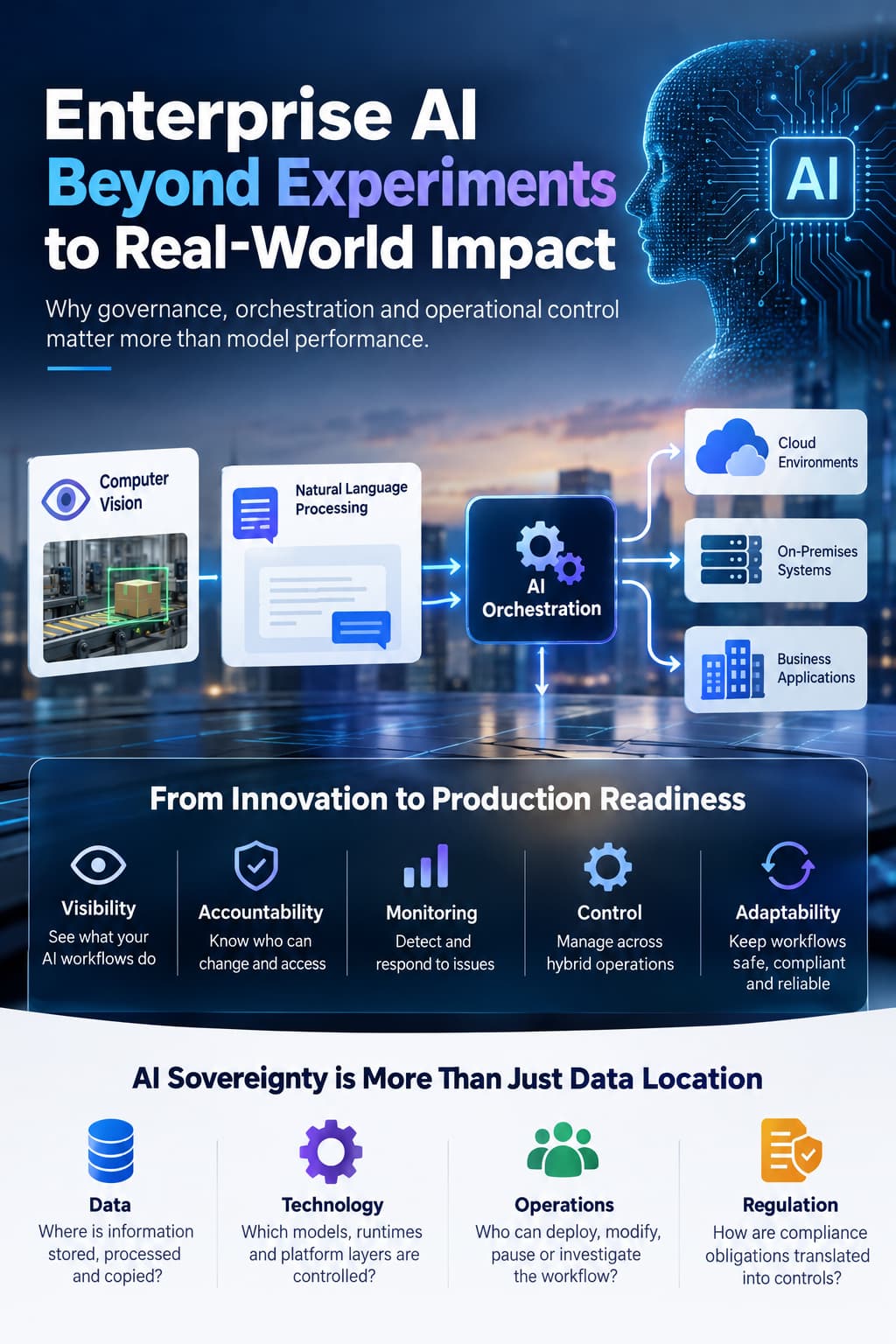
IBM’s latest enterprise AI message points to a problem many teams discover late: moving a model from a successful experiment into production is less about model quality than operational control. Whether the workflow uses computer vision, natural language processing or another model type, the difficult questions are similar: Which systems can it access? Who can change it? How do you detect failure? What happens when data, applications and infrastructure sit across different environments?
That is the practical significance of IBM connecting AI orchestration with production readiness ahead of its TechXchange event. The company’s position, reported by SiliconANGLE, is that enterprises need continuous oversight across hybrid operations, not a one-time compliance review. For founders and technology leaders, this changes the buying question. Instead of asking which model performs best in a demo, ask which operating design can keep a growing collection of automated workflows observable, accountable and adaptable.
Why computer vision and natural language processing expose the orchestration problem
Enterprise AI rarely lives in isolation. A document workflow may read an invoice, retrieve information from an internal system, ask an agent to recommend an action and then write the result into a business application. A visual inspection system may identify a defect, trigger a manufacturing response and create a record for a human operator.
Each step introduces a different control surface. Data access, model behavior, application permissions, latency, logging and human escalation all matter. Improving one component does not automatically make the complete workflow dependable. In fact, a better model can increase operational exposure if employees deploy more workflows than the platform team can understand.
That is the tension highlighted in IBM’s AI Operating Model discussion: giving employees tools to create agents can increase productivity, but it can also create a management backlog. The issue is not whether employees will experiment. The issue is whether the company can see what they have created and intervene when a workflow behaves differently from its intended design.
The hidden shift: governance becomes a live operating capability
Traditional governance often arrives as a gate. A team submits a system for review, receives approval, and moves on. That approach is poorly matched to workflows that change prompts, data sources, tools and permissions over time.
A production-oriented design treats oversight as a feedback loop. It records what a workflow is doing, watches for exceptions, routes alerts to the right owner and preserves enough context to investigate a decision. This does not eliminate review. It makes review more targeted, because operators can focus on unusual behavior instead of manually inspecting every normal transaction.
The historical pattern is familiar. When companies moved from individually managed servers to cloud computing, the winning capability was not simply access to more compute. It was the operational layer that made distributed resources visible, repeatable and governable. Enterprise AI is following a similar path, except the moving parts now include decisions and actions rather than only workloads.
The implication for builders is important: the scarce product may not be another model wrapper. It may be the control layer that connects identity, observability, policy, testing and incident response across models and business systems.
Why sovereignty is broader than where data resides
IBM’s discussion also makes a useful distinction about sovereignty. Choosing a data region answers only one question. Leaders must also understand who operates the technology, who can access the surrounding systems, who is accountable for changes and how regulatory obligations are monitored.
That creates a four-part assessment:
Data: Where is information stored, processed and copied?
Technology: Which model, runtime and platform layers are controlled by the organization or by a provider?
Operations: Who can deploy, modify, pause or investigate the workflow?
Regulation: How are applicable obligations translated into controls and kept current?
IBM says its Sovereign Core maps more than 200 compliance frameworks to controls. Figures mentioned are based on company-reported information and may change as frameworks and product capabilities are updated.
The trade-off is straightforward. A broader control model can improve visibility across a complex estate, but it can also require more integration work, ownership clarity and evidence collection. A narrow tool may be easier to deploy, yet leave responsibility divided between vendors and internal teams. The right choice depends on the sensitivity of the workflow, the organization’s operating model and the level of control it needs to retain.
A practical review before putting agents into production
Before approving an enterprise AI workflow, use this short decision framework:
Map the action chain. Identify every input, model call, tool invocation, system write and human handoff. If the team cannot draw the chain, it cannot reliably govern the workflow.
Assign an owner for each failure mode. Define who responds to incorrect output, unavailable data, excessive access, unexpected cost or a regulatory issue. Shared responsibility without named ownership is usually a delay mechanism.
Set change controls. Decide what requires review when a model, prompt, data source, permission or business rule changes. Prompt engineering can improve a workflow, but it should not become an invisible production change.
Test the boundary, not only the happy path. For ai agents, test ambiguous instructions, stale records, tool failure and permission conflicts. Penetration testing can examine security exposure, but it should sit alongside functional, operational and governance testing.
Choose deployment evidence. Require logs, alert thresholds, rollback procedures and an escalation path before measuring business impact. Reinforcement learning may be relevant to some model-development approaches, but it does not replace controls around the deployed workflow.
Connect delivery to operations. A ci cd pipeline can make releases repeatable, while monitoring and approval policies determine whether those releases are safe to operate. Treat both as part of the same delivery design.
This checklist also helps separate a platform problem from a process problem. If access is fragmented, integration may be the main constraint. If no one owns incidents, adding another dashboard will not solve the issue. If teams cannot explain why an action occurred, the workflow may need narrower permissions or clearer human escalation.
What founders should build around this shift
The opportunity is in the unglamorous layer between an AI capability and a business outcome. Products can help organizations inventory deployed workflows, trace decisions across systems, enforce permissions, compare policy against actual behavior or package audit evidence for specific operating contexts.
There is also room for services that help companies redesign processes around hybrid environments. IBM’s source discussion emphasizes that enterprise systems will continue to span multiple clouds, data stores and applications. That means customers may value architecture that preserves optionality, even when it introduces integration and support costs.
Founders should avoid treating “orchestration” as a vague synonym for automation. A credible product should answer concrete questions: What can this workflow do? With which data? Under whose authority? How is a change detected? What is the recovery path? How much of the answer can be demonstrated from system records rather than policy documents?
For buyers, the same questions make vendor comparisons more useful. Do not evaluate an individual feature as though it solves sovereignty, oversight or production reliability by itself. Evaluate how the pieces work together, what remains your team’s responsibility and whether the controls still function when the workflow crosses organizational or technical boundaries.
For more practical analysis on building and operating technology systems, explore the Yanisa Execution blog.
Enterprise AI will mature when orchestration is treated less like a feature and more like the discipline that keeps automated decisions answerable.
IBM’s announcement matters because it frames the next enterprise AI bottleneck clearly: not access to models, but the ability to operate many changing workflows across a hybrid environment. Teams that design visibility, ownership and intervention into the system from the beginning will be better positioned to compare tools on operational fit rather than demo appeal. If you are assessing that architecture, Yanisa Execution can help you compare the trade-offs and define the questions your team should take to vendors.
Frequently Asked Questions
What does enterprise AI orchestration mean?
Enterprise AI orchestration is the coordination of AI workflows across models, data, applications and infrastructure. It typically includes access control, monitoring, policy enforcement, deployment processes and human escalation.
Why is hybrid infrastructure important for enterprise AI?
Many organizations operate across multiple clouds, internal systems and data environments. A hybrid design can preserve flexibility, but it also requires consistent visibility, permissions and operating practices across those environments.
How is AI governance different from a one-time compliance review?
A one-time review checks a system at a particular point in its lifecycle. Continuous governance monitors changes, access, outputs and incidents as the workflow evolves, allowing teams to investigate and respond when conditions change.
What should companies assess when evaluating AI sovereignty?
Companies should assess more than data location. They should also examine who controls the technology layers, who operates the systems, who can change them and how regulatory obligations are translated into ongoing controls.
What should be tested before an AI agent reaches production?
Teams should test normal and failure scenarios, including ambiguous instructions, unavailable data, excessive permissions, tool failures and incorrect outputs. They should also define ownership, logging, escalation and rollback procedures.