Most outbound teams do not have a writing problem first. They have a prioritisation problem. They contact people who fit an ideal customer profile but have not shown a reason to engage.
That is why Intent-first targeting matters. The AiSDR source describes an AI sales development representative (SDR) that looks for relevant signals across the web, identifies prospects who may have a solvable problem, and shapes outreach around that context. The important change is not simply that software can draft an email. It is that prospect selection, research and message creation are being connected in one workflow.
For founders, the practical question is straightforward: can your sales process identify a credible signal, interpret it carefully and route the next action to the right person?
Why signal quality matters more than outbound volume
Traditional outbound often begins with a list. A team defines a market, collects contacts, writes a sequence and measures activity. This process is easy to count, but contact volume does not establish commercial relevance.
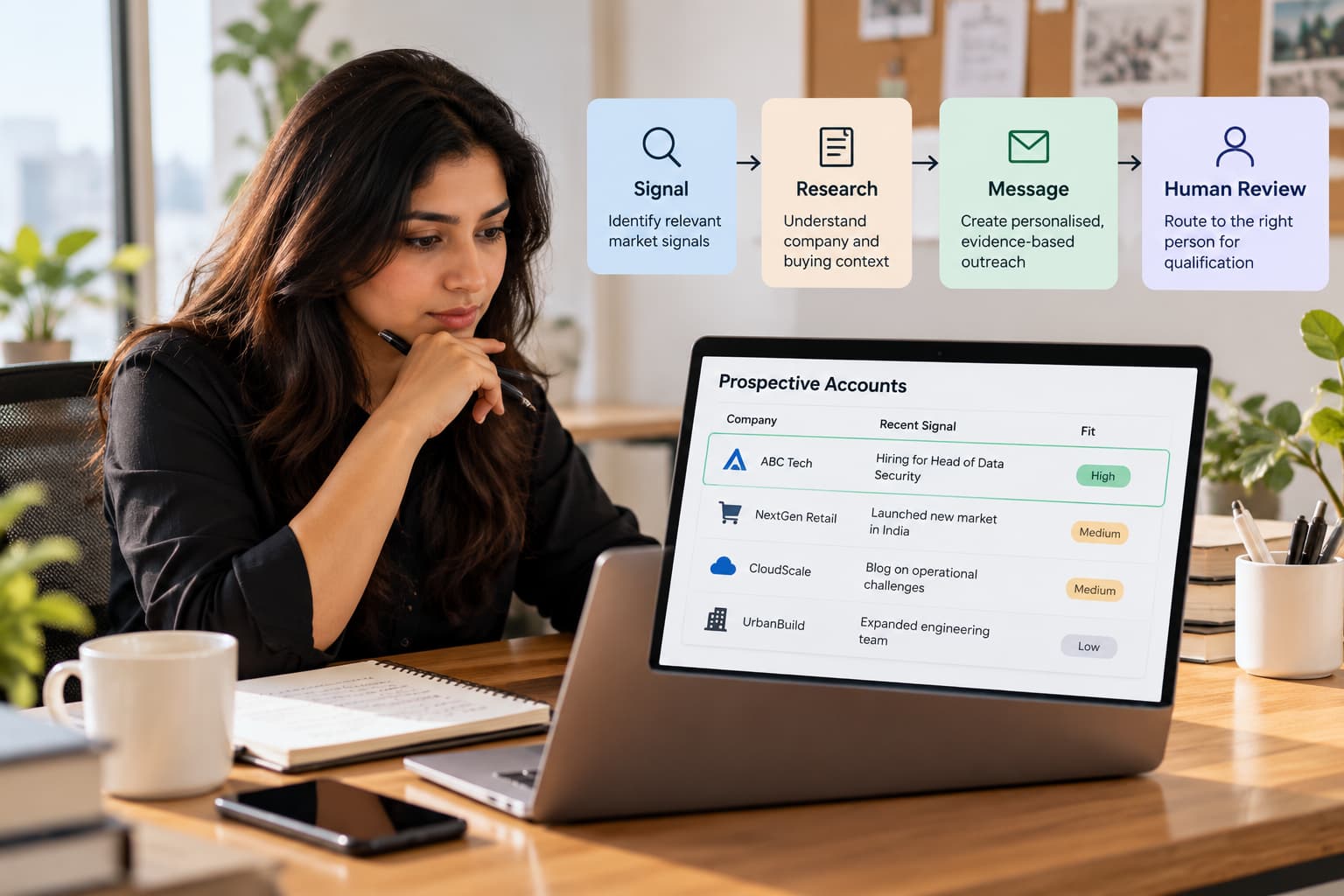
An intent-led workflow reverses the order:
Find a signal that suggests a problem, change or priority.
Check whether the company and contact fit the target account definition.
Use the signal to form a specific, evidence-based message.
Route replies to a human who can qualify the situation.
Useful signals might include a company hiring for a role related to the problem you solve, entering a new market, announcing a product change, switching technology providers or publishing material about an operational challenge. None of these signals proves that a buyer is ready. They provide context that a job title or generic industry label cannot.
The source positions AiSDR around lead quality, real-time prospect discovery and personalised outreach. Its case-study material reports examples such as 29 meetings in 30 days and a 32% reply-to-demo rate. These are vendor-reported examples, not benchmarks that every company should expect.
Figures mentioned are indicative and may vary depending on audience, data quality, offer, deliverability, campaign design and market conditions.
What changes when the SDR workflow becomes signal-driven
The first change is economic. A small company may not have the budget or management capacity to build a large prospecting function. Software that combines research, prioritisation and drafting may reduce repetitive work. The trade-off is that the team must invest more attention in defining the signals and reviewing the decisions the system makes.
The second change is operational. Research may sit in one tool, contact data in another, sequence management in a third and reporting somewhere else. Each handoff creates delay and information loss. Connecting the steps can move a relevant signal into a message faster, but it also means an incorrect signal can travel through the workflow faster.
The third change is strategic. If an AI SDR is measured by emails sent, contacts reached or tasks completed, it will favour throughput. If it is evaluated using qualified replies, accepted meetings and later opportunity quality, the team has a more useful operating objective.
The hidden shift is from automating outreach to improving the decision about who deserves outreach.
Personalisation without prioritisation is expensive decoration. A polished message sent to the wrong account is still a poor sales action.
What founders should verify before adopting an AI SDR
Do not begin with the product demo. Begin with the sales system the product will enter. Use this checklist before a pilot:
Signal traceability: Can a seller see why a prospect was selected and inspect the underlying context?
Account controls: Can you define exclusions, account tiers, seniority, geography and problem-specific criteria?
Message boundaries: Can the team control claims, tone, evidence and product-fit language?
Human routing: What happens when a reply raises a technical, commercial or sensitive question?
Suppression: Does the workflow stop or change when a prospect declines, opts out or becomes irrelevant?
Measurement: Are you tracking qualified conversations and downstream progression rather than only activity?
Data governance: What information is collected, where it is stored, how long it is retained and who can access it?
A common mistake is treating an AI SDR as a substitute for positioning. If the offer is unclear, the target market is too broad or the proof is weak, faster outreach can make the diagnosis harder.
Another mistake is allowing the system to infer too much from a weak signal. A public post about a problem may reflect research, frustration or commentary about another company. Outreach should acknowledge context carefully rather than pretend to know the prospect’s priorities.
How to design a narrow, testable AI SDR workflow
Start with one use case, not the entire market. For example, a cybersecurity startup might target companies that recently expanded their engineering team and published concerns about access control. Hiring alone does not prove urgency, so the message should treat it as a reason to investigate relevance, not as evidence that a purchase is imminent.
Next, define the handoff. A qualified reply should reach a person who understands the product, the industry and the limits of the offer. If the response is negative, the system should respect that preference. If the signal becomes stale, the prospect should leave the active sequence.
Then compare the workflow with the process it replaces. The useful test is not whether an AI-generated email sounds natural in isolation. It is whether the team can produce more relevant conversations with less manual research while maintaining factual, ethical and operational controls.
What is aisdr photo 427Intelligence over automation?
This search phrase points to a practical distinction: an AI SDR creates value through the quality of its targeting and reasoning, not merely through the number of actions it performs. Automation can execute a weak strategy faster, while useful intelligence helps determine which action is appropriate.
If you typed aisdr photo 315AI that strategizes; then executes;
You are probably looking for a sales workflow that can identify a relevant prospect, form a reasoned hypothesis about the problem and prepare outreach within defined business rules. That workflow still benefits from human review when context is ambiguous or the account is commercially important.
What is aisdr photo 346Adaptable sequences;?
In practical terms, this refers to outreach sequences that can change according to a prospect’s role, signal, response and level of engagement. Adaptability should not mean uncontrolled variation; teams need guardrails for claims, cadence, opt-outs and escalation.
What does aisdr photo 974Meetings; not activity. mean?
It describes a measurement preference: evaluate whether outreach creates relevant sales conversations rather than rewarding the number of contacts or messages processed. A booked meeting still needs qualification and does not, by itself, establish opportunity value.
The founder opportunity is a better decision layer for sales
The opportunity is not another generic email generator. It is the layer that connects market signals to responsible commercial action. That could mean vertical-specific signal collection, systems that verify claims before outreach, workflows that score buying context or analytics that connect the first reply to later sales stages.
For an early-stage company, document the target account definition, list the signals that genuinely matter, create a review policy and run a constrained pilot. Keep the audience narrow enough that the team can inspect why each prospect was selected. Broader coverage can come later if quality remains acceptable.
Yanisa Execution shares practical approaches to AI, automation and business systems for teams making these decisions. The right approach depends on your sales motion, data access, account complexity and tolerance for operational overhead.
AiSDR reflects where outbound software is moving: from managing sequences to interpreting context. The companies that benefit may not be the ones sending the most messages. They may be the ones that turn credible signals into timely conversations without surrendering judgment.
Frequently Asked Questions
What does an AI SDR do?
An AI SDR may support sales development tasks such as prospect research, prioritisation, message drafting and follow-up workflows. The exact capabilities depend on the product, integrations and controls configured by the team.
How does intent data help outbound sales?
Intent data provides contextual signals that may indicate a company or person is researching a problem, changing direction or becoming more relevant to an offer. A signal does not prove buying readiness, so it should be evaluated alongside account fit and human judgment.
Can an AI SDR personalise sales emails?
Many AI SDR products can draft messages using information about a prospect, company or observed signal. Teams should review factual claims, tone, relevance and product fit before messages are sent.
What should I measure in an AI SDR campaign?
Track qualified replies, accepted meetings, sales-cycle progression and opportunity quality rather than relying only on sends, opens or raw activity. The appropriate measures depend on your sales motion and qualification criteria.
Does an AI SDR replace a human sales development representative?
An AI SDR may reduce repetitive research and drafting work, but positioning, qualification, relationship judgment and escalation can still require people. The division of work depends on account complexity, deal size, data quality and review standards.