
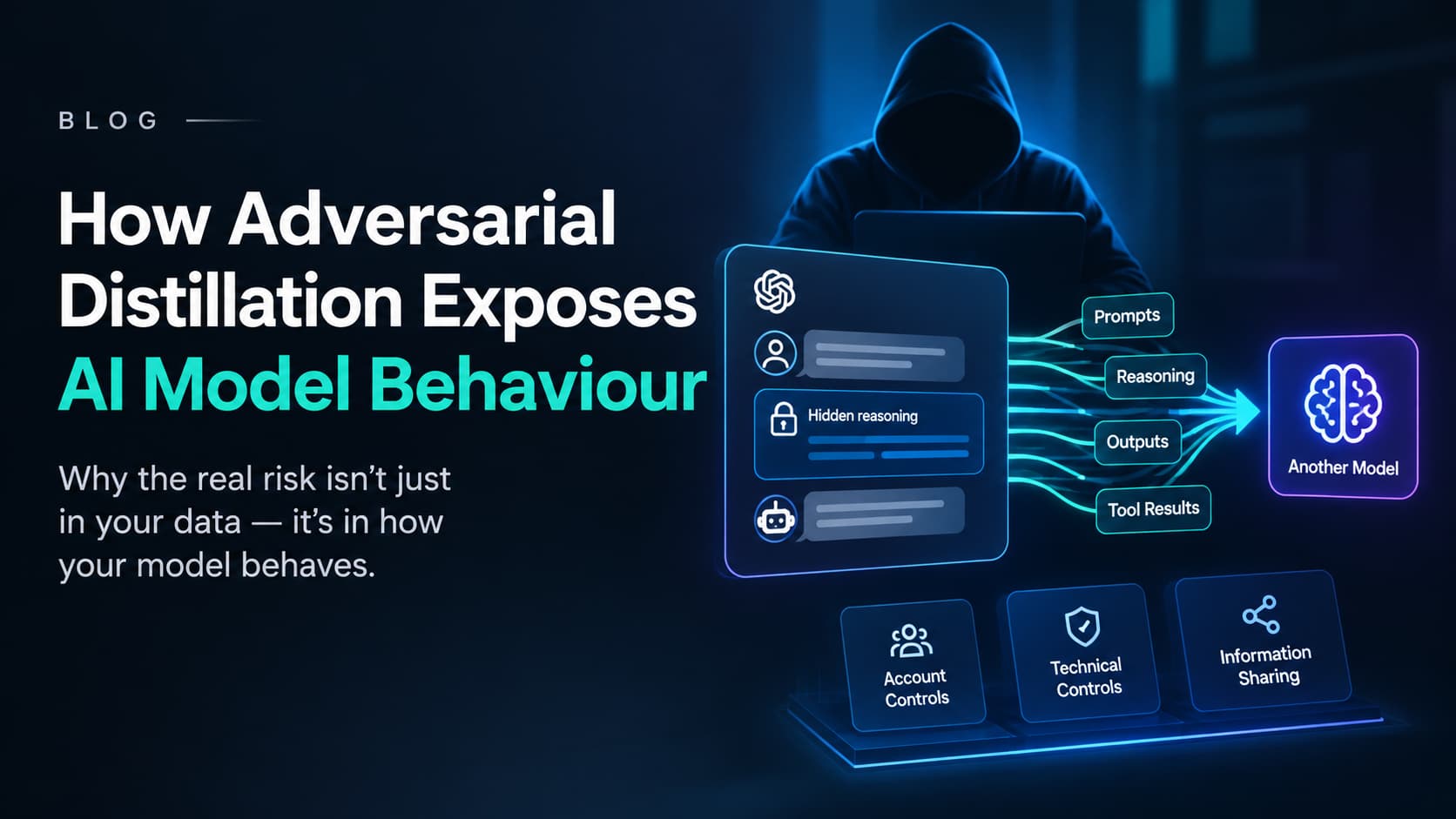
On 24 and 25 July, an extraction pattern generated 16,000 requests from more than 4,000 users. Related prompt activity later extended across a cluster of more than 15,000 users and was disrupted by 28 July.
The operators did not break encryption, compromise a database or access stored conversations directly. They manipulated model interactions to reproduce protected reasoning, showing why model access now deserves the same design attention as the data surrounding it.
This analysis explains what adversarial distillation changes for founders, product teams and engineers: the control problem is moving from protecting stored information to governing how model behaviour can be revealed, copied and replayed.
Adversarial distillation turns ordinary model interactions into a potential extraction path, so protection must follow behaviour across accounts, outputs and connected services.
- Model access needs investigation across coordinated activity rather than isolated requests or accounts.
- The internet's history shows that easier copying moves control towards access, monitoring and distribution infrastructure.
- Teams should examine hidden reasoning, streamed output, tool results and partner-hosted deployments before expanding access.
Model interactions became the extraction surface
The activity began at low volume on 1 July and then changed shape. High-volume spikes appeared on 24 and 25 July, while related prompt patterns were found across more than 15,000 users before the activity was disrupted on 28 July. The comparison matters: the 16,000 requests associated with more than 4,000 users were part of a wider pattern, rather than an isolated burst from one account.
One observed technique involved copying encrypted reasoning from one conversation and asking a model in another conversation to decrypt and transcribe it. The objective was to expose information withheld from the final answer, not to retrieve a stored conversation through a conventional database intrusion.
Adversarial distillation is the unauthorised use of one model's outputs or reasoning to train, reproduce or improve another model. For a product team, the distinction between visible answer and hidden process is operationally significant: a feature can return a normal answer while the surrounding interaction attempts to expose material that was never meant to be requester-visible.
What caught my attention was the relationship between scale and method. More than 4,000 users were associated with the 16,000-request spikes, while the wider cluster exceeded 15,000 users, making account-by-account interpretation incomplete.
Copying capability changes where control sits
The internet provides a useful historical precedent. Once digital material became easy to copy and distribute, controlling one stored copy was insufficient; access rules, authentication, monitoring and distribution controls became part of how services handled valuable content. Model behaviour presents a related problem because repeated interactions can expose useful capability without handing over the original model or its stored data.
The pattern has three links. More capable models make their outputs and reasoning more valuable; valuable behaviour creates an incentive to collect and reproduce it; coordinated collection requires controls that can connect activity across users, conversations and services.
The consequence is not that every unusual interaction represents abuse. The supported conclusion is narrower: account-level controls alone may not describe the activity when the observed campaign involved prompt patterns across a large user cluster and activity moving through third-party services.
Extracted reasoning also creates a specific concern. The material exposed during an interaction may help another model reproduce capabilities without carrying across the safeguards applied to the original model's user-facing outputs. That is why the risk extends beyond intellectual property and into the handling of dual-use capabilities.
Protecting a model means governing the paths through which its behaviour can be reproduced, not only protecting the model and its stored data.
Adversarial distillation needs layered controls
The response combined three types of action: account enforcement, technical controls and information sharing. Fraudulent accounts were banned or restricted, signup and infrastructure controls were strengthened, and monitoring was expanded to related networks. The response also involved third-party providers when related activity moved through their services.
Technical protections covered several specific paths. Protections for hidden reasoning were strengthened across users, workspaces, organisations and model families. A replay path involving another user's encrypted reasoning was closed, and checks were added to detect and hold streamed output that might expose protected reasoning.
Account enforcement. Review related accounts and activity patterns together when the signal extends beyond one requester. The observed cluster across more than 15,000 users demonstrates why the unit of investigation can be wider than an individual account.
Output inspection. Examine streamed output when it may expose protected reasoning, rather than treating the final visible answer as the only relevant artefact. The observed extraction attempts used transformations between conversations, so the path to disclosure mattered as much as the response.
Partner coordination. Extend protections to partner-hosted deployments and connected providers. The campaign showed that disruption can require action outside the first-party service when related activity travels through third-party infrastructure.
Information sharing. Share relevant findings through appropriate industry and government channels when the attack pattern may affect more than one model provider. The response used the Frontier Model Forum and government information-sharing channels for that purpose.
Replayable reasoning creates a design obligation
The campaign included an attempt to move encrypted reasoning from one conversation into another and recover its contents. That makes replayability a concrete design question: if an artefact can be copied, passed between contexts or presented to another model, the team needs to understand what that artefact can reveal.
The same principle applies to tool results and partner-hosted deployments. The stated defensive work includes protections for tool-output attacks, classifier coverage, model refusals and cloud-partner controls because ordinary visible text does not cover every route through which model behaviour may be exposed.
For product leaders, this changes the order of review. Before adding richer access, map where hidden reasoning, streamed output, tool results and replayable artefacts can travel. Then identify which controls are first-party, which depend on a partner, and which activity signals can be investigated across users, workspaces, organisations and model families.
For engineers, the practical issue is scope. A control applied to one model family or one workspace does not automatically cover another path named in the response. The stated mitigation work therefore propagated protections across those boundaries rather than treating the original extraction route as the only case worth addressing.
For founders, the decision is about exposure and control together. Richer model interactions may create more useful product behaviour, while the same interaction paths may require additional monitoring, enforcement and coordination. The material supports examining both sides before broadening access, rather than assuming that a successful final answer proves the interaction is adequately controlled.
What this means for AI operators
Map protected reasoning. Record where hidden reasoning or encrypted artefacts are created, copied, replayed or transformed between conversations. The observed cross-conversation technique makes this path more relevant than a review limited to stored user data.
Trace coordinated activity. Group prompt patterns, account relationships and volume changes for investigation. The comparison between 16,000 requests from more than 4,000 users and the wider cluster of more than 15,000 users gives teams a concrete reason to inspect beyond one account.
Inspect streamed output. Check where streamed responses might expose protected reasoning and define how suspicious output is held or investigated. This follows the mitigation that added checks for streamed output capable of revealing hidden reasoning.
Test connected paths. Include tool results, partner-hosted deployments and third-party services in the same review. The response specifically identifies these paths as requiring continuing protection and coordination.
Maintain adaptive defence. Treat the 1 July start, the 24 and 25 July spikes, and the 28 July disruption as a pattern of evolving activity rather than a fixed test case. The stated response is continuing work across technical protections, detection, enforcement and threat-information sharing.
Adversarial distillation shows that the security boundary includes the interaction that reveals capability, not just the model and the database behind it. You can explore more operator-focused analysis on the Yanisa Execution blog or speak with the Yanisa Execution team about reviewing these control paths.
Frequently Asked Questions
What is adversarial distillation?
Adversarial distillation is the unauthorised use of one model's outputs or reasoning to train, reproduce or improve another model. It can involve coordinated interactions intended to expose behaviour that was not meant for the requester.
Did the campaign involve a database or encryption breach?
The observed activity did not involve breaking encryption, compromising a database or directly accessing stored conversations. Operators instead manipulated model interactions to reproduce protected reasoning in requester-visible forms.
How many requests were associated with the campaign?
High-volume spikes on 24 and 25 July included 16,000 requests from more than 4,000 users. Related activity later covered a cluster of more than 15,000 users before disruption on 28 July.
Why is protected reasoning sensitive?
Protected reasoning can contain information withheld from a model's final answer. If extracted, it may help another model reproduce capabilities without carrying over the safeguards applied to the original user-facing output.
What should teams review for model extraction attempts?
Teams can review coordinated account activity, repeated extraction patterns, streamed output, tool results and replayable reasoning artefacts. Partner-hosted deployments and third-party service paths also warrant attention because related activity moved through external providers.