Atlassian’s latest announcement answers a question many product and engineering leaders are postponing: what happens when humans and AI agents work on the same tasks, documents and decisions? The answer is not simply a better chatbot. It is a shared work environment where computer vision can help interpret what a person points to, natural language processing can capture intent, and permissions determine what an agent is allowed to do.
According to reporting by SiliconANGLE, Atlassian introduced its Agentic Multiplayer Protocol, or AMP, alongside updates to Rovo, Loom, developer context and its Model Context Protocol server. The company’s direction is significant: agents are being treated less like background software and more like participants with identity, authority and defined scope.
Why Atlassian’s computer vision approach matters beyond better prompts
Most business automation assumes that work can be expressed as a clean text instruction or a fixed sequence of steps. Real work is rarely that tidy. A product manager may circle a part of a screen, explain what feels wrong and ask for a revised version. An engineer may need an agent to understand a ticket, the relevant code, internal documentation and the commercial reason behind the work.
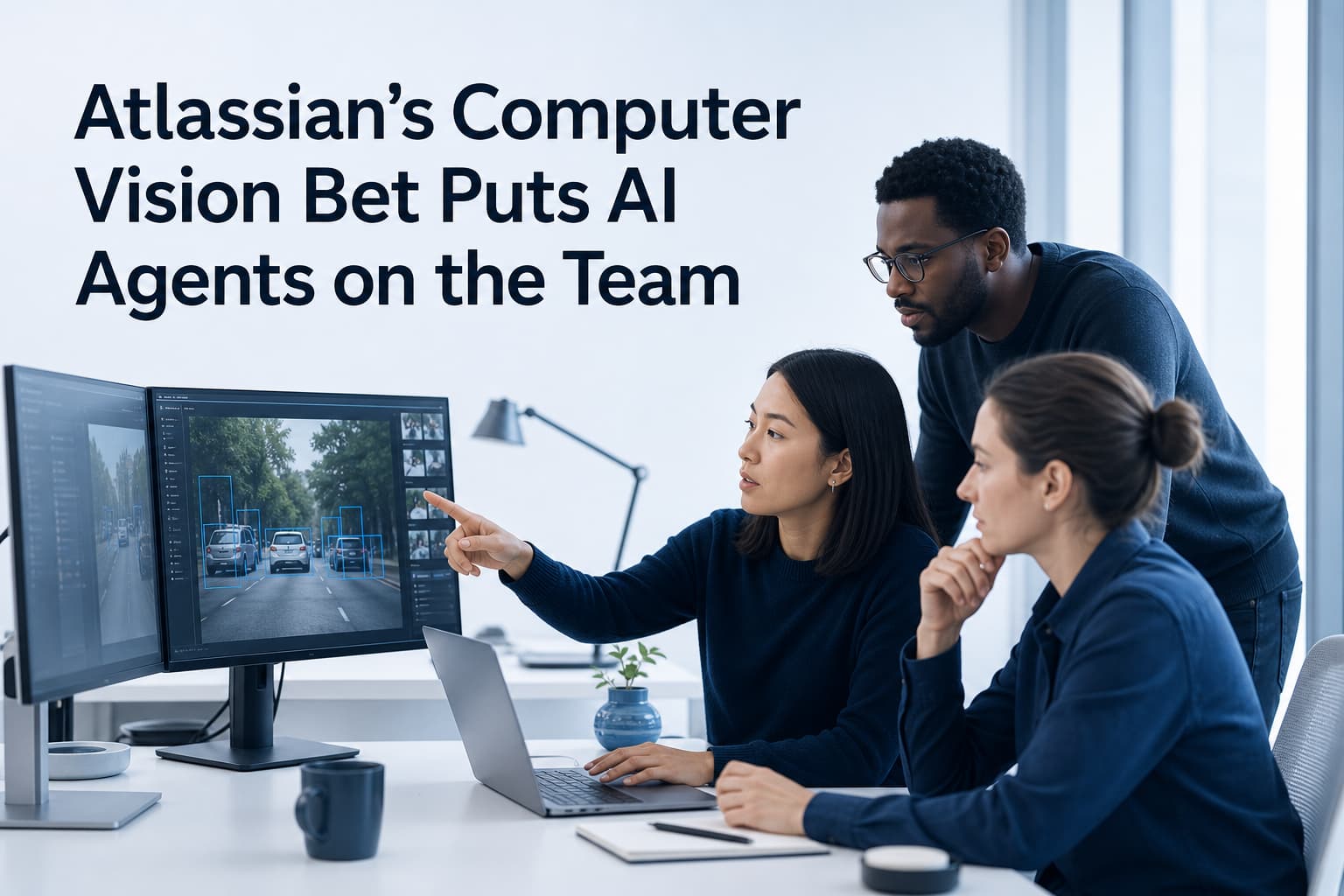
Loom’s role in the announcement is revealing. It can capture a person’s screen, spoken explanation and visual references, such as a marked interface element or a button being clicked. That gives an agent more context than a written instruction alone. It also reflects a broader product principle: people often communicate intent more accurately by showing a problem than by describing it in abstract terms.
The trade-off is a larger governance surface. A screen recording may expose customer information, internal systems or confidential plans. Before using visual instructions in production, teams need retention rules, access controls and a clear answer to who can inspect, reuse or export the resulting context.
Shared context changes the unit of automation
AMP matters because it treats collaboration as a stateful system. An agent can receive an objective, operate within a defined scope and leave work for a person or another agent to review. That differs from asking a model for an answer and manually transferring the result into a project tool.
SiliconANGLE reported that Atlassian’s expanded Model Context Protocol server exposes 200 tools and handles roughly 15 million tool calls daily. Figures mentioned are indicative of the source report and may change as the product evolves; teams should verify current capabilities in Atlassian’s documentation before making architecture or procurement decisions.
The more consequential detail is that agents are increasingly writing information back into work systems, rather than only retrieving it. Once an agent can create or modify tasks, documents or project records, the central question changes from “Does this answer sound plausible?” to “Was this action authorised, traceable and reversible?”
This follows the same pattern as collaborative software. Shared documents became more useful when teams could see edits, ownership and comments in one place. Version control became more useful when changes could be attributed, reviewed and merged. Agent collaboration is moving in the same direction: context creates usefulness, but accountability makes that usefulness deployable.
The strategic shift is from AI that produces output to AI that participates in a controlled chain of work.
What product and engineering leaders should take from Rovo Work
Rovo Work is designed for longer, multi-step tasks. A user sets the objective, allows the agent to investigate and assemble a plan, then reviews the proposed work and result. That model may be useful for research, documentation and first drafts, but it does not remove the need for acceptance criteria. A vague objective creates a longer process that is harder to inspect.
The source report also describes Rovo attempting to learn how to handle unfamiliar tasks by researching instructions and obtaining the necessary tooling. This is an important boundary. A system that can adapt its approach may handle more varied work, but its behaviour can be less predictable than a narrow workflow. The practical response is to restrict which tools, data sources and output channels it can use, rather than treating adaptation as a substitute for governance.
For engineering teams, Atlassian’s broader context layer connects source code with tickets, documents and structured data from systems such as Databricks, Snowflake and BigQuery. The potential value is better alignment between what is being built and why it is being built. The cost is architectural: teams must determine which records are authoritative, how stale information is detected and what happens when two systems disagree.
What caught my attention is the direction of travel. The difficult part is no longer only getting an agent to generate a useful response. It is giving that agent enough context to act while keeping its authority narrow enough to review.
A decision framework for introducing AI agents into real workflows
Do not begin with “Where can we add an agent?” Begin with the workflow and its failure modes. Use this checklist before selecting a vendor, connecting data or granting write access.
- Define the handoff: Identify where a person gives the agent an objective and where a person must review the result.
- Separate permission tiers: Treat read access, draft access, edit access and publish access as distinct capabilities.
- Make context inspectable: Record which documents, tickets, code or visual references influenced the result.
- Set reversal rules: Decide which actions can be undone, which require approval and which should remain manual.
- Measure operational quality: Track rework, escalation, review time and policy exceptions, not only task volume.
A common mistake is confusing a successful demonstration with a reliable operating process. A demo can show an agent completing a complicated task. Production requires defined permissions, observable intermediate steps and a recovery path when the agent misunderstands the objective.
Where the supporting technologies fit
Visual instruction is not a replacement for written requirements. It is a second channel for communicating spatial or interface-specific intent. Likewise, natural language processing can help interpret spoken or written requests, but the surrounding workflow still needs structured fields, ownership and approval states.
Prompt engineering can improve the initial instruction, but the larger gain often comes from improving the information available to the agent and constraining the actions it can take. Reinforcement learning may influence how a system adapts, but it does not decide whether a proposed action should be permitted.
Security teams should evaluate these systems through access reviews, audit trails and carefully scoped penetration testing. Engineering leaders should also test what happens when a dependency is unavailable, a document conflicts with a ticket or a human changes the same record during execution.
What founders should build around this shift
The opportunity is not another generic assistant. It is the control layer around collaborative work.
Potential product directions include systems that map agent identity to business permissions, record decision provenance, detect conflicting edits or translate visual instructions into structured tasks without losing the original context. Another opportunity is testing and observability for agent workflows: teams will need to replay actions, compare outcomes and identify where an agent exceeded its intended scope.
For developers, the same principle applies to a ci cd pipeline: the useful product is not merely a bot that proposes a change, but a governed path that shows what changed, which checks ran, who approved it and how to roll it back. The value is in the reviewable path, not just the generated code.
Founders should also pay attention to the interface between human intent and structured systems. Loom’s visual instruction model suggests that many automation failures begin before the model runs: the user has not expressed the task in a format the system can reliably interpret. Products that capture intent, preserve context and route approval may create more durable value than products focused only on generating text.
What this means for your next automation decision
Atlassian’s announcement does not mean every team should adopt agent-led workflows. It does show where enterprise software is heading: shared spaces in which people and software act on the same records, with different permissions and responsibilities.
If you are evaluating this model, start with one workflow where the objective is clear, the data boundary is manageable and a human can review the output. Avoid beginning with irreversible actions or broad access to disconnected systems. Expand only after the team understands the agent’s failure modes and can explain every material change it makes.
For more practical analysis of automation and product systems, explore the Yanisa Execution blog. You can also compare the checklist above with your current workflows before deciding whether a deeper implementation is appropriate.
Frequently Asked Questions
What is Atlassian Agentic Multiplayer Protocol?
Agentic Multiplayer Protocol is Atlassian’s approach to letting humans and AI agents work in the same governed environment. It is designed to give agents identity, context, permissions and defined scope while people guide and review their work.
How does Rovo Work differ from a standard AI chatbot?
Rovo Work is designed for longer, multi-step tasks rather than only responding to a single request. The user sets the objective and can review the plan and result while the agent works within available tools and permissions.
Why is shared context important for AI agents?
Shared context lets an agent connect a request with related documents, tasks, code and business information. It may improve relevance, but it also increases the need for access controls, data ownership rules and audit trails.
Can AI agents edit Atlassian documents and tasks?
The source report says Atlassian is expanding support for agents that write information back into its platform. Whether an agent can edit or publish content depends on the permissions and controls configured for that environment.
Can Loom replace written instructions for AI agents?
Loom can make instructions clearer by showing the relevant screen area, action or desired change alongside spoken explanation. It is better understood as an additional input method rather than a replacement for clear requirements, structured workflows or review.