
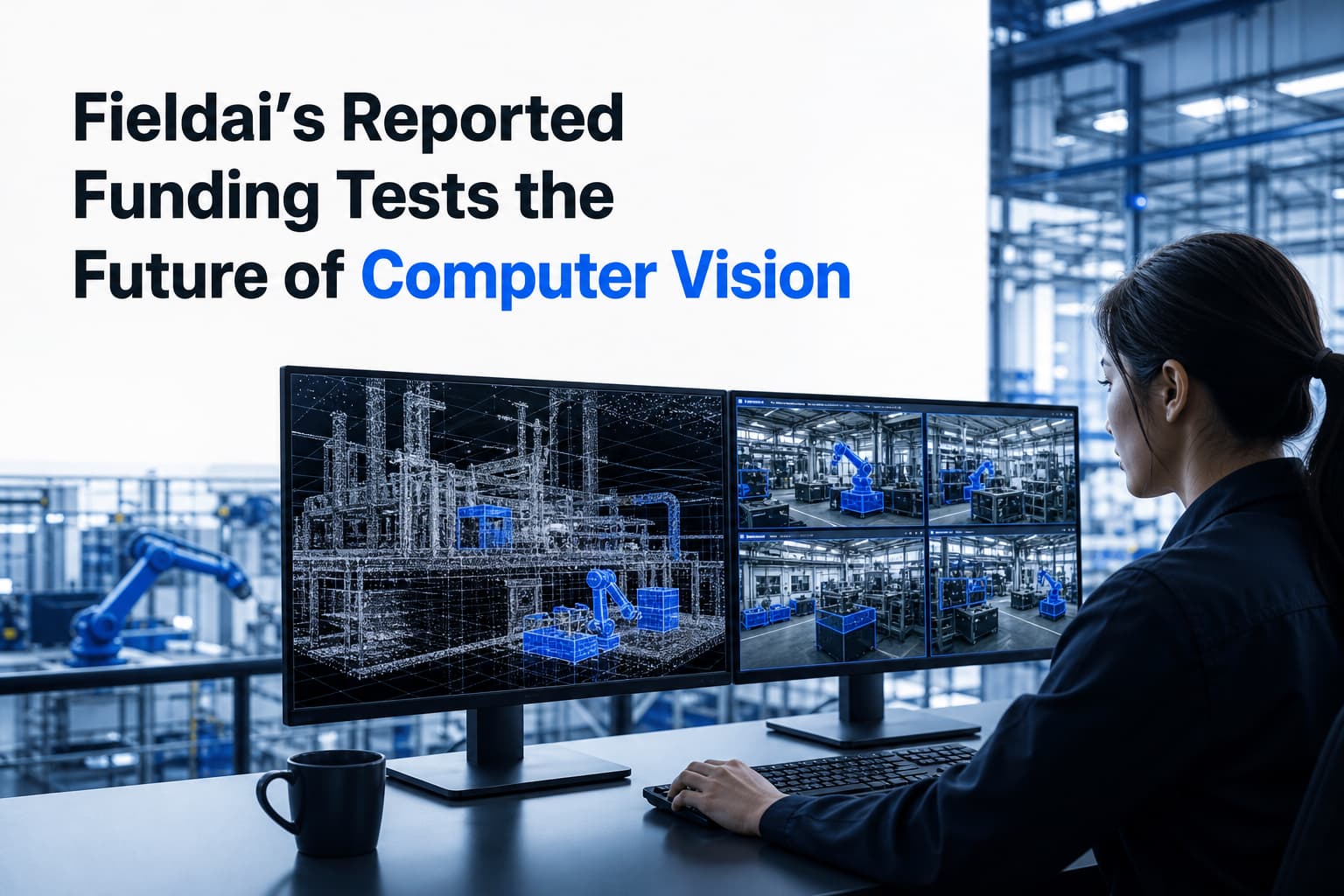
FieldAI’s reported funding round matters because it puts a sharper question in front of robotics founders: can adaptable computer vision make physical automation economical outside controlled environments? The company is reportedly seeking $700 million at a potential $10 billion valuation, while its models are designed to navigate changing sites without prebuilt maps, GPS or a live internet connection. The broader opportunity may extend beyond navigation, with natural language processing helping operators describe inspection tasks and receive structured reports.
Figures mentioned are reported or indicative and may vary depending on transaction terms, verification, documentation and market conditions.
The reader-level answer is straightforward: this is less a story about one funding round than a signal that the valuable layer in robotics may be moving toward reusable intelligence that reduces site-specific setup. That shift is attractive only if the technology also survives safety reviews, integration work and the economics of real deployments.
Why FieldAI’s reported funding matters to robotics operators
According to the source report, citing Business Insider, FieldAI may be raising $700 million at a valuation of $10 billion. The report says that valuation would be five times the company’s reported worth in the previous August. It also describes a term sheet, which is a preliminary fundraising document, rather than a confirmed completed transaction.
Figures mentioned are reported or indicative and may vary depending on transaction terms, verification, documentation and market conditions.
That distinction matters. A reported valuation reflects investor expectations, not necessarily realized revenue or profitability. Still, the reported traction is notable: FieldAI is said to have more than 30 customers across construction, energy and the public sector, with revenue and customer contracts reportedly exceeding $135 million by June and later topping that level.
Figures mentioned are reported or indicative and may vary depending on transaction terms, verification, documentation and market conditions.
The commercial signal is that customers may be paying for reduced deployment friction, not merely for a robot that performs a fixed demonstration. Industrial environments change. Construction sites are rearranged, factory lighting fails, equipment moves and network access can be inconsistent. A static map or manually specified route can become a maintenance obligation.
Computer vision becomes more valuable when the site keeps changing
Traditional robotics deployments often begin with environment mapping, route definition and extensive site configuration. That approach can work in a stable warehouse. It becomes harder to justify when every new location requires specialists to recreate the same setup process.
FieldAI says its models use inputs from cameras, lidar and radar to build a continuously updated digital twin of the operating environment. A digital twin is more than a fixed simulation: it changes as the physical site changes. Operators can potentially use it to test a factory-floor modification, inspect equipment or examine how a robot may respond to a new obstacle before making a physical change.
This turns perception into a coordination layer. The system must interpret sensor data, identify hazards, understand spatial relationships and choose an appropriate response. Slowing down when lighting deteriorates is a simple example, but it shows the difference between a rule-based robot and one that can adjust to context.
Natural language processing is relevant at the operational edge rather than as a substitute for safety controls. A technician might describe an inspection objective, after which software could translate that request into bounded steps, check whether conditions are suitable and return a structured finding. The hard problem remains execution: the system must know when its interpretation is uncertain and when a person should intervene.
The historical pattern: value moves from machines to coordination layers
Containerized shipping provides a useful precedent. The container did not create value by itself; standardized handling allowed ships, ports, trucks and warehouses to coordinate around a shared unit. The advantage came from reducing friction between separate parts of the system.
Robotics may be following a similar path. The physical robot remains essential, but reusable perception and navigation can reduce the amount of bespoke work required at each site. If that pattern holds, the value pool expands around model deployment, sensor integration, simulation, safety validation and operational monitoring.
The effect chain is conditional but clear:
- More adaptable models may reduce mapping and route-configuration work.
- Lower setup effort can make automation more practical in smaller or less predictable sites.
- More deployments create operational data about failures, environmental changes and edge cases.
- That data supports better testing, simulation and deployment tooling, creating demand for specialist software around the robot.
The constraint is equally important. A model that performs well in one warehouse may behave differently around dust, glare, occlusion, unusual layouts or unreliable connectivity. The relevant metric is not how capable the system looks in a controlled demonstration; it is how much recurring work and risk it removes in the customer’s actual environment.
Where founders can build without manufacturing the robot
The obvious mistake is to build a broad robotics layer without identifying the operational failure that customers repeatedly pay to solve. FieldAI’s reported approach points to more specific opportunities.
1. Deployment and environment-change tooling
Products can focus on detecting when a site has drifted from its validated state, replaying past incidents and showing which routes or assets require review. This may be more valuable than another generic dashboard because it connects directly to maintenance and safety decisions.
2. Simulation and validation
Teams need to test changes before they reach a live robot. A useful system could combine digital-twin data with scenario generation, sensor replay and staged release controls. This is where reinforcement learning may help in simulation or controlled environments, but learned behavior still needs explicit limits when equipment, workers or production are involved.
3. Cross-hardware deployment
The source says FieldAI’s models can run across systems ranging from autonomous vehicles to humanoid and four-legged robots, and describes support for Boston Dynamics’ Spot robot for industrial inspection. That portability is strategically significant, but it should be tested task by task. Perception may transfer more easily than control, and an inspection workflow may not transfer to material handling.
4. Human-to-robot task translation
There is room for ai agents that convert an operator’s intent into constrained inspection or monitoring workflows. The distinction matters: an agent should be evaluated on permission boundaries, auditability and recovery behavior, not just on whether it can produce a plausible instruction.
A practical checklist before investing in robotics intelligence
Before funding an internal project or selecting a vendor, assess the following:
- Environment: Does the site change often enough that static maps and fixed paths create a measurable operational burden?
- Evidence: Has the system been tested under poor lighting, sensor disagreement, network loss and unexpected obstacles?
- Safety: Are speed, location, uncertainty thresholds and human escalation rules explicit?
- Economics: Does the avoided setup, downtime or manual inspection work justify sensors, integration and ongoing support?
- Transfer: Can the software support more than one site, task or robot configuration without a new engineering project each time?
- Release control: Can teams simulate, stage, monitor and roll back model or behavior changes through their existing delivery process?
For security-minded operators, penetration testing is a useful analogy. The goal is not simply to prove that the intended route works. It is to deliberately probe failure modes and document what the system does when assumptions break.
Searchers using the phrase “ci cd pipeline” are generally looking for a continuous integration and continuous delivery workflow. In robotics, that workflow needs simulation, device compatibility checks, staged field validation and a clear rollback path, because a software release can change physical behavior.
Figures mentioned are reported or indicative and may vary depending on transaction terms, verification, documentation and market conditions.
What operators should do next
Robotics startups should sell evidence of deployment reliability rather than model novelty. Show how the system behaves when maps are stale, sensors disagree, lighting changes or the network disappears. Buyers should ask for the integration workload, intervention rate, monitoring design and conditions under which the system must stop.
Investors should separate three questions: is the model technically capable, can it be deployed economically, and does it create repeatable value across customers? FieldAI’s reported customer count and contract figure may suggest commercial momentum, but they do not establish that every deployment will have the same economics.
My view is that the hidden opportunity is not “robots everywhere.” It is the software that makes variable physical environments legible, testable and manageable. That is a narrower claim, but it is also a more useful one for founders deciding where to build.
The next valuable robotics company may not own the machine; it may own the layer that helps machines understand unfamiliar ground.
FieldAI’s reported financing is therefore a signal about where power may move in robotics: from isolated hardware toward adaptable perception, simulation and deployment control. The companies that earn durable trust will still need to prove performance in the field, explain failure clearly and make the total operating cost visible.
For more analysis on AI, automation and product strategy, explore the Yanisa Execution blog or speak with the team about comparing deployment options for your operating environment.
Frequently Asked Questions
What is FieldAI reportedly raising funding for?
FieldAI is reportedly seeking funding for its robotics artificial intelligence business, including models designed to help robots navigate and operate in changing environments. The reported transaction is described as a potential financing round with a term sheet, not as a confirmed completed deal.
Can FieldAI robots operate without GPS or internet access?
FieldAI says its models can operate without GPS, an internet connection, prebuilt maps or user-defined travel paths. Actual performance would depend on the robot, sensors, site conditions, safety controls and deployment design.
What industries does FieldAI serve?
The source report says FieldAI has customers in construction, energy and the public sector. It also describes an integration with Boston Dynamics’ Spot robot for industrial inspection tasks.
Why are digital twins useful in robotics?
A digital twin provides a continuously updated representation of a physical environment. Operators may use it to review site conditions, test proposed changes and support training or validation before making changes in the real environment.
What should a company check before buying robotics AI?
A company should assess performance in changing conditions, sensor and hardware requirements, safety boundaries, integration effort, monitoring, rollback procedures and total deployment cost. Reported funding or customer traction does not establish that a system will fit every site or produce a particular financial outcome.