
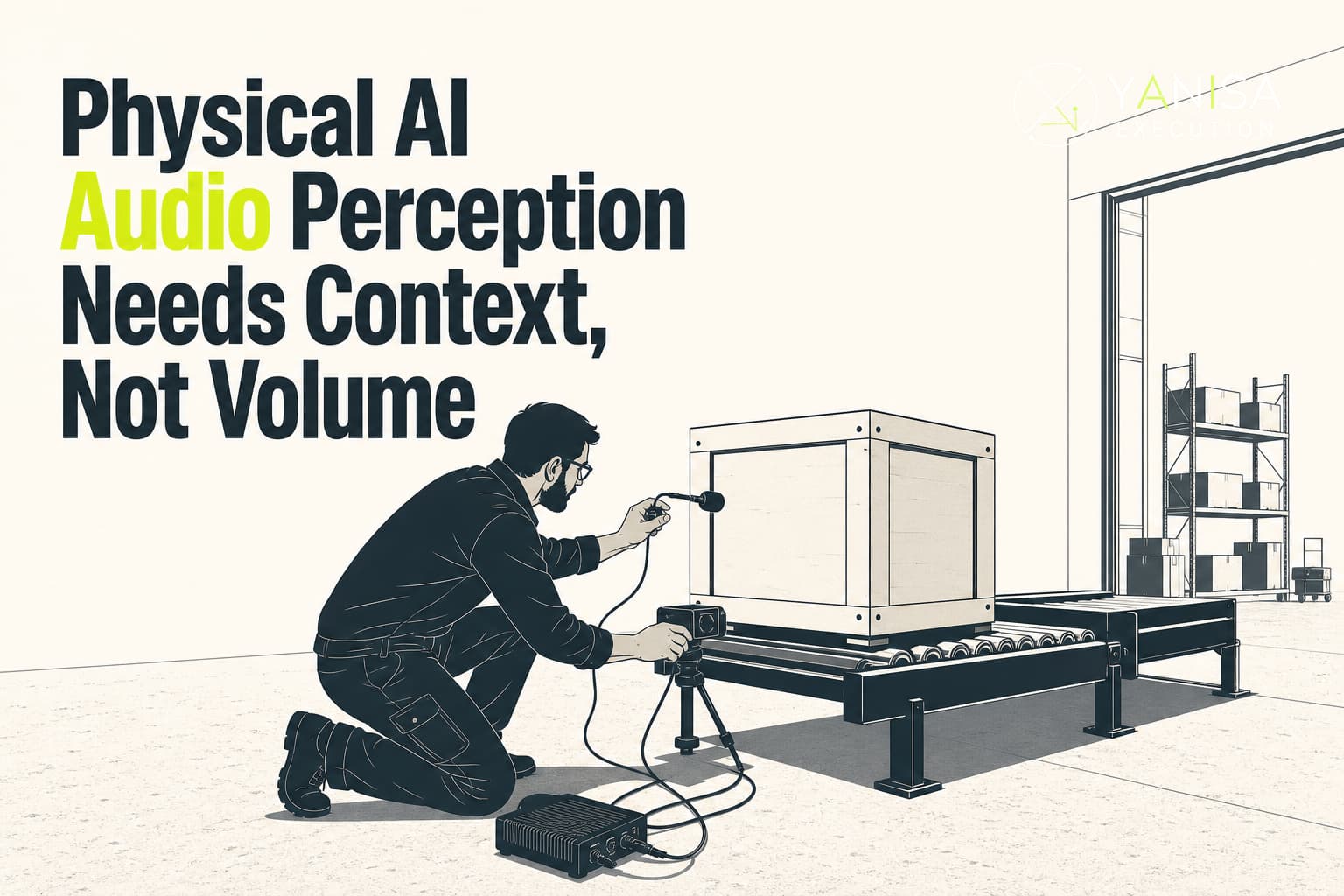
Edge Sound has raised $2 million, taking its total funding to $9 million, to develop audio infrastructure for physical AI. The problem appears clearly in a sports arena, where microphones capture the sound of a basketball, crowd noise, music and announcements at the same time.
For founders building AI systems that interact with the physical world, the question is not simply how to collect more sound. The useful work is associating a sound with the right object, place and moment. This piece explains why that mapping layer matters, how latency changes the design, and where teams should be cautious before extending the approach into new environments.
Physical AI audio perception becomes useful when sound is connected to objects, locations and other sensor data.
- Raw microphone channels need spatial and visual context before software can associate sound with a specific object.
- Latency targets should follow the decision being supported, because sports broadcasting and vehicle perception have different timing requirements.
- Founders should validate audio perception in a focused environment before assuming that performance transfers to robots or vehicles.
Physical AI audio perception is an association problem
A microphone records from a position. It does not, by itself, identify which object produced a particular sound. In Edge Sound’s sports example, the same audio environment contains the ball, players, spectators and loudspeakers, so isolating one event requires more than a clean recording.
The proposed answer has two connected parts: a spatial representation of the environment and machine-learning models that separate sound elements. Customers can import a 3D space or 2D layout, place sensors at coordinates and use microphone locations and pickup patterns alongside player tracking. This gives the audio signal a setting in which it can be interpreted.
The effect chain is specific: microphones produce channels, the spatial map supplies location, and visual or tracking data helps associate a sound with an object. That association can identify a player, ball, coach or referee in the arena example, although the result remains dependent on the available sensors and models.
For product teams, define the objects and events that matter before selecting an audio model. If the system cannot describe what a sound belongs to, adding another feed may increase the amount of data without resolving the interpretation problem.
Vision has a useful partner in sound
Cameras are already common in everyday environments and have received much of the attention in physical AI. Audio contributes a different kind of evidence. A vehicle, for example, may need to detect a siren approaching from a blind corner before the sound-producing vehicle appears in a camera view.
Direction can be inferred from differences in how sound reaches microphones, while a change in pitch can indicate whether a siren is approaching or receding. These signals do not remove the need for cameras or other sensors. They add another input that can be paired with visual information when the environment makes sight incomplete.
Electricity provides a useful historical precedent, with one important limitation. It became broadly useful through networks, equipment and applications rather than through generation alone; the value came from connecting the underlying resource to a setting where people could use it. Audio perception follows a similar pattern in this narrow sense: the microphone is the starting component, while the map and associated sensor data determine how the signal can be applied.
That comparison does not establish that every physical AI system needs audio. It does show why the product boundary is moving from collection towards interpretation. A team with a clear object, location and event model has a more concrete design problem than a team simply adding microphones to an existing machine.
Latency sets the product boundary
Real-time perception is constrained by when an interpretation arrives. Edge Sound cites a sub-33-millisecond tolerance for sports broadcasting, while other environments may tolerate 100 or 200 milliseconds. These figures are application examples, not a universal target, and the difference changes the engineering trade-off.
In a live broadcast, audio must stay closely aligned with an unfolding sporting event. In another environment, a wider delay may be acceptable if the signal is used for a less time-sensitive task. The correct target therefore follows the decision the system supports, rather than the model’s headline processing speed.
Broadcasting. A sub-33-millisecond requirement leaves limited room for slow processing between sound isolation, object association and the final output. The benefit is tighter synchronisation; the cost is a narrower timing budget and a more demanding integration task.
Vehicles. A siren-detection use case may tolerate 100 or 200 milliseconds, as described for other environments. That wider window can change the system design, but direction and timing still need to be tested in the intended setting before a human or vehicle relies on the signal.
Robotics. A robot may require another target based on what the audio output is meant to support. Teams should set that target after defining the event and response, then retain human review while the system is being evaluated.
The correct latency target follows the decision the system supports, rather than the model’s headline processing speed.
Focused markets make transfer possible, not automatic
Edge Sound started with sports, where crowded audio creates a visible and repeatable perception challenge. Its Virtual Sound Engine is commercially deployed across the industry, and the company has worked with Shure, the National Basketball Association, Fox Sports Media Group and the United States Tennis Association.
That sequence offers a useful decision rule for founders. A first market should provide a concrete environment in which the system’s sensors, spatial representation and timing can be tested together. It should also expose what changes when the same components move to a different setting.
The company says the new funding will support integration with existing enterprise customers and make its components transferable across industries ahead of a Series A. The stated direction is hardware independence, allowing the software and models to work with microphones and cameras already used in customer systems where that integration is practical.
What transfers. The spatial mapping approach, model structure and relationship between audio and visual data may provide a starting point for another application. Transfer still depends on the new environment’s sensor placement, sound conditions, objects and timing requirements.
What does not transfer automatically. Commercial sports deployment does not establish performance in an autonomous vehicle or robot. Each new setting changes the physical layout and the events the system must interpret, so the original market should be treated as validation evidence rather than universal proof.
What remains with the operator. Integration decisions, sensor placement and human review still shape the deployment. The system can assist interpretation, but teams should define how a person checks important outputs and what happens when audio and visual data disagree.
What this means for your physical AI roadmap
The practical decision is where to invest first: more data collection, better spatial context, tighter timing or stronger integration with existing sensors. The facts above point towards a sequence that keeps the problem concrete.
Map the environment. Represent the relevant 2D or 3D space, place the sensors and name the objects that matter. The value is a clearer relationship between a sound channel and the physical event it may describe; the cost is additional modelling and integration work.
Define the timing requirement. Use the sub-33-millisecond sports example alongside the 100 or 200 milliseconds cited for other environments. Select a target from the supported decision, then test it with the people and systems that will receive the output.
Pair audio with existing evidence. Combine audio with camera or tracking data where those signals are already available. This may improve object association, while increasing the number of interfaces and failure points that require testing.
Start with one bounded market. Sports offers a documented commercial setting for this approach. A robot, vehicle or workplace may be a later application, but its different layout, sound environment and timing needs should be validated separately.
Keep human review in the loop. Show the associated sound, location and supporting sensor information together during evaluation. That creates a practical way to inspect interpretation before the system is trusted with more consequential actions.
Physical AI does not become more capable simply because it hears more signals. It becomes more useful when software can relate sound to a place, an object and the other evidence available in that environment.
Founders can explore related execution thinking on the Yanisa Execution blog, then compare the mapping, latency and review requirements against their own workflow.
Frequently Asked Questions
Why is audio useful in physical AI systems?
Audio can provide information that cameras may not capture, such as a siren approaching from a blind corner. Its usefulness depends on associating the sound with a location, object and other sensor data.
What does a digital twin mean in audio perception?
In this context, it is a spatial representation of an environment containing sensor positions and coordinates. Software can use that representation to relate audio signals to locations and objects.
What latency does real-time audio perception require?
The requirement depends on the application. Edge Sound cites a sub-33-millisecond tolerance for sports broadcasting, while other environments may tolerate 100 or 200 milliseconds.
Can physical AI audio replace cameras?
Audio is presented as a complementary signal rather than a replacement for vision. Pairing sound with visual or tracking data can help associate an event with an object, subject to the system’s sensors and models.
Where is audio perception already being used commercially?
Edge Sound’s Virtual Sound Engine is commercially deployed in sports broadcasting and has been used with Shure, the National Basketball Association, Fox Sports Media Group and the United States Tennis Association.